

What Is Thermal Shock in Glass? Understanding Sudden Temperature Changes...
Read MoreWhat Is Thermal Shock in Glass? Understanding Sudden Temperature Changes
A glass container may tolerate gradual warming and still crack if one part changes temperature quickly. Imagine a warm candle jar that meets a splash of cold water. The wetted surface cools first. The glass just beneath it remains warmer for a short time. Those layers are attached to each other, so they cannot change size independently. The resulting stress is the starting point for understanding thermal shock in glass.
A thermometer can tell you how warm a surface is at a particular spot. Thermal shock depends on the temperature differences that develop within the object and on how the object responds to them. The rate of change, the area exposed to heating or cooling, the shape of the glass and the condition of its surface all influence the outcome.
The same physics helps explain why a warm jar can be particularly vulnerable to sudden cooling and why two apparently identical pieces can respond differently. Following the change from uneven temperature to stress, and then from stress to fracture, makes those differences easier to understand.
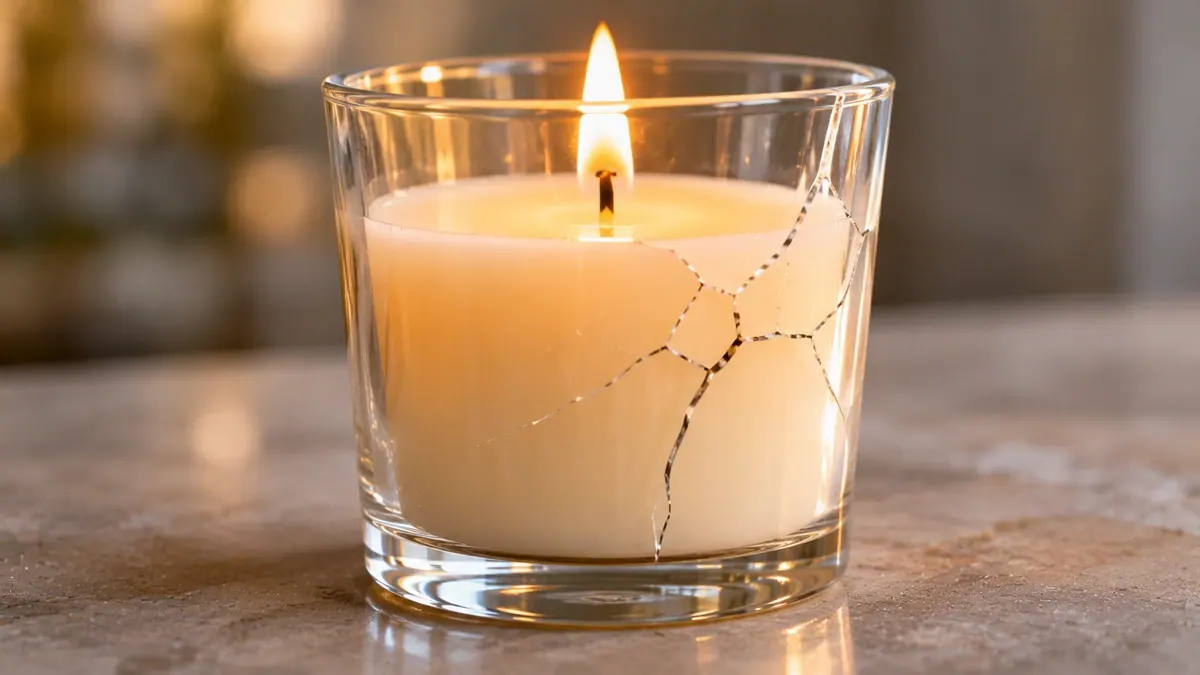
How a sudden temperature change creates stress
Glass normally expands as it warms and contracts as it cools. The amount it would expand freely for a given temperature rise is related to its coefficient of thermal expansion. Consider a small square marked on a sheet of glass. If the sheet warms gradually and evenly and has room to expand, that square can grow along with the material around it. There may be little stress from the temperature change itself.
Now imagine cooling only the face of a warm sheet. The surface wants to contract while the warmer material below it still occupies almost the same space. The warmer interior restrains the cooler surface, putting it in tension. Tension is a pulling stress. It can open a surface flaw in much the same way that pulling on either side of a small cut opens it wider. Other parts of the sheet can be in compression, which tends to press surfaces together.
Rapid local heating can also create thermal stress. Exploring heat transfer through glass candle containers clarifies how an off-centre flame or rising hot gases can create steep temperature gradients across the wall and base. The hot area wants to expand against cooler surrounding glass. The heated region and nearby regions can experience different stresses, depending on the shape and how heat enters. In a jar, the wall, rim and base are all connected, so a temperature change concentrated at the bottom can affect the stress near the curve where the base meets the wall.
Why the rate and location of cooling matter
A warm jar left to cool in ordinary room air loses heat through its exterior. Meanwhile, energy from the warmer interior moves towards the cooler exterior. Given time, these exchanges reduce the differences within the glass. Understanding candle curing vs cooling reinforces why gradual room-temperature cooling protects both the wax matrix and the surrounding glass vessel. Cold liquid in direct contact with part of the jar can remove energy from that patch much more rapidly. The temperature of the patch drops while the surrounding material stays warm, creating a sharper gradient.
Think of two jars beginning at the same temperature and eventually returning to the same room temperature. The first cools gradually in air. The second has one warm patch suddenly cooled by water. The final temperature tells you nothing about the largest temperature difference either jar experienced along the way. The second jar can see a brief, sharp change near the wetted area even though both jars end up at the same temperature.
Location matters as much as speed. Cooling an exposed face over a broad area can set up a difference through the thickness. Cooling a narrow band can also set up a difference along the wall. A real jar can develop both at once. This is one reason a temperature difference quoted for a particular test should travel with its test conditions. A result from one exposure method cannot automatically be applied to a different shape or cooling pattern.
How a tiny flaw becomes a visible crack
Glass can support considerable loads, but its strength in practice is sensitive to flaws. A scratch, chip or microscopic crack changes how stress is distributed. The stress near the tip of a flaw can be much larger than the stress averaged over the wall. When tension acts in a direction that opens the flaw and the driving force is sufficient, the crack can extend. In brittle glass, that extension can happen quickly.
The flaw that starts the break can be too small to see. An intact-looking jar therefore tells you little about its resistance to a severe temperature change. Visible chips or cracks are clear reasons to stop using a candle container. Repeatedly heating a damaged jar to see whether it holds adds a new load to glass that already has a defect.
A crack by itself rarely identifies the cause. An impact can create a crack, and prior damage can make later thermal loading more consequential. Manufacturing stresses, handling and local heating may all contribute. In a technical investigation, the fracture surfaces and the circumstances of failure matter. A crack photographed from the outside can document where damage is visible, but it may not reveal where the crack began.
What changes thermal shock resistance
Expansion and heat flow
For comparable conditions, a glass that expands less with temperature tends to develop less stress from the same uneven change. This is one reason low-expansion glasses are used where temperature swings are expected. How quickly heat spreads inside the glass also matters. Heat must move far enough through the material for a temperature difference between two regions to diminish. A lower expansion coefficient helps, while the geometry, mechanical properties and flaw condition still affect whether a crack grows.
Thickness and shape
Thickness affects how quickly a change at the surface reaches the interior. Reviewing how to choose a candle vessel for DIY candle making highlights how container wall geometry and material selection influence thermal durability during burning. A thicker section can retain a warm interior for longer during rapid cooling. The transition from a thick base to a thinner wall can also lead to different heating or cooling rates in adjacent regions. Sharp changes in shape can influence how the resulting stresses are distributed. A jar’s weight or thickness alone gives an incomplete picture of its resistance.
Residual stress and surface condition
Glass can retain internal stresses after forming if different regions cool unevenly during manufacture. Annealing is a controlled heating and cooling process that reduces residual stress. It improves the starting conditions for the finished part. In use, a new temperature gradient can still generate stress. Damage from handling also changes the condition of the surface, so manufacturing history and subsequent use both matter.
What candle glass testing can tell you
A controlled thermal shock test defines how samples are conditioned, how the temperature change is applied and how damage is assessed. A test result describes the specimens under that procedure. A comparison becomes more meaningful when vessel shape, starting conditions and exposure method are clear. Trying an improvised hot-to-cold test at home can produce sharp fragments and supplies little information about normal candle use.
ASTM F2179 sets out performance requirements and associated tests for certain annealed soda-lime-silicate glass containers made for candles. Its scope includes thermal shock and annealing. That scope matters when reading a supplier’s claim. A test of the container addresses the vessel under specified conditions. A finished candle adds a particular wick, wax fill and heating pattern. A finished design also needs to be evaluated as an assembly under an appropriate procedure.
During ordinary use, keep the candle on a stable, heat-resistant surface and follow the maker’s instructions for burn duration and when to stop. Reviewing expert candle care tips to make candles last longer reinforces safe extinguishing routines—such as using a snuffer instead of water—so hot glass cools gradually. Let the jar cool before moving it. Keep cold water away from hot candle glass, including when extinguishing the flame. The temperature of the jar can remain uneven even after the flame is out because warm wax and glass continue exchanging energy.
Key Takeaways
- Thermal shock develops from uneven temperature rates: Fractures occur when one section of a glass container heats or cools significantly faster than adjacent layers.
- Rapid surface cooling creates pulling tension: When an outer layer contracts quickly while the interior stays warm, tensile stress pulls microscopic surface flaws apart.
- Microscopic flaws concentrate fracture stress: Scratches, chips, or prior impact damage act as weak points where thermal stress triggers sudden cracks.
- Material expansion and geometry govern resistance: Lower thermal expansion, proper factory annealing, and smooth base-to-wall transitions improve thermal shock durability.
- Never cool hot candle glass with water: Always extinguish flames with a snuffer or lid and allow warm vessels to return to room temperature undisturbed.
Frequently Asked Questions
Does thermal shock only happen when glass cools?
Rapid cooling is a common example because the cooler surface can go into tension. Rapid or highly localised heating can also generate stress as warmer glass tries to expand against cooler areas. The location and direction of the resulting stress depend on the geometry and heating pattern.
Is there a single temperature difference that cracks glass?
There is no universal difference for every glass object. A test value depends on factors such as the material, wall thickness, surface condition and how the temperature change is applied. A local splash and slow cooling in air can produce very different gradients from the same starting temperature.
Can a candle jar crack after the flame is extinguished?
Yes. The glass and wax can stay warm, and their temperatures can vary across the vessel. Sudden cooling during that period can create additional stress. Let the jar cool where it is before handling it, and retire the candle if the container is cracked or chipped.
Does annealing make glass immune to thermal shock?
Annealing reduces stresses left behind by manufacturing. Uneven heating and cooling can still introduce new stresses in use. The actual response depends on the glass, vessel shape, surface condition and temperature pattern.
Is thermal shock the same as damage from impact?
Impact applies a mechanical load, while thermal shock creates stress through uneven expansion or contraction. The two can interact. A chip left by an earlier impact may act as a starting point for a crack during a later temperature change.
Why does a crack sometimes travel beyond the cold patch?
The cold patch may create the stress that starts the crack. Once a crack begins, stresses elsewhere in the vessel can help it continue through the glass. The visible line can extend beyond the area where the temperature first changed.
Glass and candle safety references: Corning technical guide to glass thermal properties • ASTM F2179 candle glass specification • National Candle Association candle safety tips
About Studio Kinza
Studio Kinza is a Dubai-based artisanal candle studio located in Warsan, International City, crafting clean-burning handcrafted soy candles from non-toxic botanical waxes and fine fragrance oils. Through hands-on workshops, masterclasses, and educational guides, we explore the science behind candle materials, scent, and combustion.
Plan Your Experience
Curious to explore vessel selection, wick sizing, and custom fragrance blending in a guided studio setting? Contact the Studio Kinza team to reserve workshop seats, arrange private group sessions, or enquire about bespoke candle experiences in Dubai.

Heat Transfer Through Glass Candle Containers
How Does Heat Travel Through a Glass Candle Container? Look...
Read More

How To Photograph Candlelight
How to Photograph Candlelight Without an Orange Colour Cast A...
Read More