

What Is Thermal Shock in Glass? Understanding Sudden Temperature Changes...
Read MoreHow Does Heat Travel Through a Glass Candle Container?
Look at a lit candle in a clear glass jar and you can see the flame, the liquid wax near the wick and the solid wax below it. What you cannot see is the temperature pattern in the glass. The rim, side and base can all be at different temperatures, and the pattern can change as the wax level falls. A single reading on the outside wall captures only one part of that picture.
Heat transfer through glass candle containers is easiest to understand by following the energy. The flame releases energy. Warm gases, radiation and warmed wax carry some of it towards the glass. Within the solid wall, energy spreads by conduction. At the outer surface, the glass transfers energy to the room and, where it makes contact, to the surface beneath the jar.
This explains why two jars can feel different even when their candles look similar. The position of the flame, the shape of the vessel and the way the jar loses heat all matter. Glass thermal conductivity is one part of the answer. To understand the whole pattern, consider where heat enters, how far it travels and where it leaves.
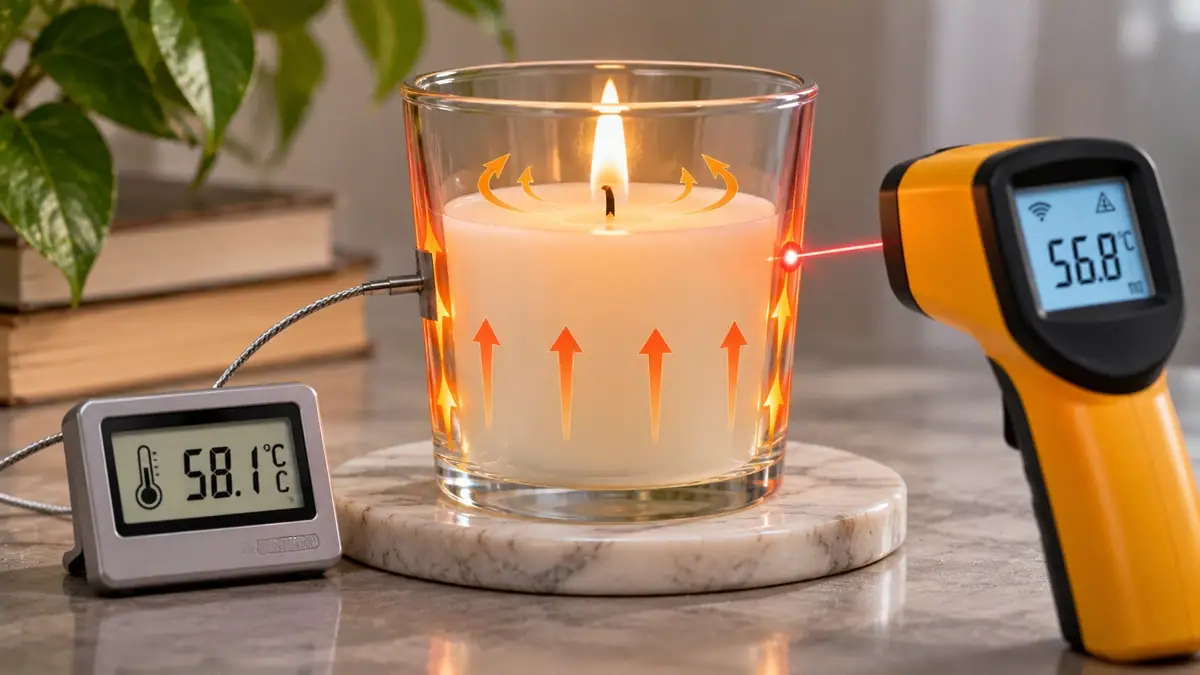
How the flame heats the glass
The flame heats the air and combustion gases around it. These warm gases rise and can warm the upper part of the container as they pass. The shape of the jar and the position of the flame influence where the flow goes. A flame close to one wall can expose that side to a different heating pattern from the opposite wall, especially if air movement makes the flame lean.
Radiation also transfers energy from the flame to its surroundings. It can cross the space between the flame and the wall without direct contact. The jar absorbs some of that energy, while some is transmitted or reflected depending on the glass and the wavelengths involved. A clear jar transmits visible light well, but its appearance alone tells you little about how it interacts with radiation at other wavelengths.
Wax provides another path. The flame warms the wax around the wick, and a liquid pool forms. Understanding why candle wax melts and the science of candle making clarifies how radiant heat builds that liquid reservoir before it touches the container wall. If warmed wax contacts the glass, energy can cross that boundary. The location of that contact changes as the candle burns. Picture an upper wall exposed mostly to warm gases and a lower wall touching wax. Both can receive energy, through different combinations of pathways. The warmest spot depends on the balance of these inputs and the rate at which each region loses heat.
What conduction does inside the glass
Conduction is energy transfer within a material driven by a temperature difference. In the glass wall, energy moves from warmer regions towards cooler ones. It can move across the thickness, from the inner surface towards the outer surface, and along the glass, from a warmer patch into adjacent regions. There is no need for the glass itself to flow or change shape for this to happen.
Thermal conductivity describes how readily a material conducts heat. Glass generally conducts heat less readily than metals such as aluminium. Reviewing how to choose a candle vessel for DIY candle making highlights how different container materials and wall thicknesses manage thermal stress during a burn. That lower conductivity helps explain why heat introduced at one location can create a local warm region instead of spreading rapidly throughout the entire jar. The temperature gradient is the change in temperature over a distance. A given temperature difference across a short distance creates a steeper average gradient than the same difference across a longer distance.
For a simplified flat wall of uniform material, the rate of conduction per unit area increases with the temperature difference between the faces and decreases with thickness, if the surface temperatures are held fixed. For example, doubling the thickness in that model would halve the rate per unit area with those same temperatures. In an actual candle jar, the face temperatures can change too. The thicker wall can alter the rate of warm-up, the outside surface still exchanges heat with the room, and the wall can conduct energy sideways. The flat-wall example isolates one effect without predicting a specific jar temperature.
Why the wall, rim and base warm differently
The wall can have gradients in two directions
At one height, the inner surface may be warmer than the outside surface. Along that same wall, a region nearer the wax pool or flame may also be warmer than another region several centimetres away. These are two different gradients. If you imagine a cross section through the wall, one gradient points across the thickness and the other follows the height of the jar. An external temperature reading at one point cannot resolve both.
Wick position adds a third dimension to the picture. The closest wall may receive more energy than the far side. With multiple wicks, the warmer regions can overlap. Even when the flames appear symmetrical, conditions outside the jar may differ if one side is near an air current—as explained in our guide on candle flame airflow science. A temperature map depends on both the source inside and the surroundings outside.
The base also exchanges heat with the support
Energy can reach the base through the glass and the wax above it. The base can then pass some of that energy into a support where the two surfaces touch. A flat bottom and a raised foot give different patterns of contact. Where a gap remains, air and radiation can still transfer energy, but the direct path through solid contact is reduced. The temperature of the support and its material affect the exchange as well.
A thick base can contain more glass than a section of the side wall. Its temperature can respond more slowly when energy is first supplied, depending on how much heat reaches it and how much leaves. Later in the candle’s life the flame and melt pool may sit lower in the vessel, changing where the energy enters. This is one reason the first session gives an incomplete picture of the temperatures a design can reach during use.
Why the jar stays warm after the flame goes out
Glass and wax store thermal energy while the candle burns. When you extinguish the flame, that input ends, but stored energy can still move between the wax, the inner wall and the outer wall. Imagine a warm layer of wax against the inside of a jar whose outside has already begun to cool. Heat can continue flowing through the glass even as the whole assembly loses energy to the room.
This delay matters when comparing observations. A reading immediately after extinguishing reflects a different stage from a reading after the wax has solidified and the jar has returned to room temperature. It can also take time for the temperature at a particular spot to respond to changes near the flame. The peak at one spot may occur at a different time from the peak elsewhere. Describing when a reading was taken is as important as describing where.
How to interpret a candle jar temperature reading
A maker or lab technician comparing vessels should record the location and timing of each measurement, the wick and fill configuration, and the room conditions. Following structured documentation routines—similar to those used when learning how candle burn time is measured—ensures vessel comparisons remain repeatable across burn cycles. A reading from the middle of one wall is easiest to compare with a reading from the same position on another sample at the same stage in its burn cycle. Comparing the rim after a short session with the base after a long session mixes location and time.
An infrared thermometer estimates surface temperature from detected infrared radiation. Its interpretation depends on the target’s emissivity, meaning how effectively the surface emits thermal radiation, as well as the instrument’s measurement area and the reflected radiation reaching it. On a small or curved jar, aiming at a spot does not guarantee that the entire measurement area is on that spot. The reading also does not directly give the temperature of the wax or the opposite face of the wall.
A suitable measurement setup can help compare designs, but a single number does not establish whether a jar is safe. ASTM F2179 addresses performance requirements for specified annealed glass containers made for candles, including thermal shock and annealing. Container performance and the behaviour of the finished candle are separate considerations. For everyday use, follow the candle’s instructions, let the vessel cool before moving it and avoid sudden cooling with water.
Key Takeaways
- Three pathways heat the glass: Rising warm gases, thermal radiation, and direct contact with the liquid wax pool transfer energy into different parts of the jar.
- Conduction creates local gradients: Because glass conducts heat relatively slowly compared to metal, temperatures vary across both wall thickness and jar height.
- Geometry and wick placement matter: Off-centre wicks, air drafts, and base contact with tabletops create distinct hot spots around the container.
- Stored heat lingers after extinguishing: Thermal energy continues flowing from warm interior wax through the glass wall even after the flame is put out.
- Location and timing define valid readings: Accurate temperature comparisons require recording exact spot coordinates, emissivity settings, and elapsed burn time.
Frequently Asked Questions
Does heat travel upwards through glass?
Heat conducts through solid glass towards cooler regions, which can be above, below or beside a warm spot. Warm gases tend to rise. That upward motion is convection and can heat the rim before conduction redistributes some of that energy within the glass.
Is a thicker candle jar always cooler on the outside?
The outside temperature depends on how much heat enters, how it travels and how much the outer surface loses. Wall thickness affects conduction and heat storage, while the flame position, wax level and airflow can all change the result.
Why does one side of the jar feel warmer?
The flame or melt pool may be closer to that side. Outside airflow can also cool one side more quickly. Either effect can create a difference around the circumference, and the two effects can occur together.
Does a clear jar let all the flame’s heat through?
Clear glass transmits much of the visible light. It can still absorb energy from radiation and receive heat from hot gases or wax. The ability to see through the jar does not tell you its surface temperature.
Why is the glass still warm after I extinguish the candle?
The wax and glass have absorbed energy during the burn. That energy continues to spread through the vessel and escape into the room during cooling. Wait for the candle and container to cool before handling them.
Can a jar temperature tell me if a candle is safe to burn?
One reading applies to one location and moment. Evaluating a finished candle requires a suitable procedure and consideration of its behaviour over time. For an individual candle, follow the maker’s directions and stop using a cracked or damaged vessel.
Heat transfer and candle glass references: OpenStax heat transfer methods • ASTM F2179 candle glass specification • National Candle Association candle safety tips
About Studio Kinza
Studio Kinza is a Dubai-based artisanal candle studio located in Warsan, International City, crafting clean-burning handcrafted soy candles from non-toxic botanical waxes and fine fragrance oils. Through hands-on workshops, masterclasses, and educational guides, we explore the science behind candle materials, scent, and combustion.
Plan Your Experience
Curious to explore vessel selection, wick sizing, and custom fragrance blending in a guided studio setting? Contact the Studio Kinza team to reserve workshop seats, arrange private group sessions, or enquire about bespoke candle experiences in Dubai.

Heat Transfer Through Glass Candle Containers
How Does Heat Travel Through a Glass Candle Container? Look...
Read More

How To Photograph Candlelight
How to Photograph Candlelight Without an Orange Colour Cast A...
Read More