Why Can You Sometimes See a Candle Flame in Daylight?...
Read MoreWhat Is Fragrance Oxidation? How Exposure to Air Can Change Aromatic Materials
A fragrance can smell different after exposure to air because some of its ingredients have changed chemically. A bright citrus note may seem less distinct, or an unfamiliar note may appear alongside the original scent. Those changes can have several causes. Fragrance oxidation specifically describes a reaction that changes the molecules in the material. The original molecules are consumed as new compounds form.
A fading scent by itself tells you very little about which process took place. Some compounds may simply have escaped into the air. Others may still be present in the liquid but enter the air at different rates when you smell a sample. To make sense of air exposure and scent, it helps to ask what changed in the material and what changed in the air above it.
The fragrance chemistry behind oxidation is easiest to see in a single ingredient such as linalool. A finished candle fragrance is a more complicated mixture. Its ingredients can change at different rates, and the way you smell the blend depends on how those ingredients and their reaction products reach your nose.
What fragrance oxidation means
Oxidation is a broad term in chemistry. In the context of aromatic material stability, the process of interest is often autoxidation, in which a compound reacts with molecular oxygen under ordinary exposure conditions. An oxygen atom need not be added in every individual step. The overall process can produce a mixture of compounds with properties different from those of the starting material.
Think of a sample that contains one fragrant compound. Before exposure, it contributes its own characteristic odour. If some of it reacts, the sample now has less of the starting compound and some amount of the products. Those products may smell different, be harder to detect, or stay in the liquid more readily. The original scent can change because a familiar contribution shrinks, because a new contribution becomes noticeable, or because both happen together.
The word aromatic can cause confusion here. In fragrance writing, it often describes a substance that has an odour. In organic chemistry, aromaticity has a specific structural meaning associated with certain ring systems. A fragrant molecule can undergo oxidation without containing an aromatic ring. For this discussion, aromatic materials simply means materials used for their scent.
How oxygen participates in a chain reaction
The first reactive molecules
Many examples of autoxidation involve radicals, molecules or molecular fragments with an unpaired electron. A small amount of radical formation can initiate a chain. The route to that first radical depends on the ingredient and its surroundings. Light or the breakdown of reactive compounds already in the material can contribute in some systems. How the chain starts is one reason two samples with similar ingredients can behave differently.
Once a suitable radical forms, it can react with oxygen to form a peroxyl radical. That radical can take a hydrogen atom from another molecule, forming a hydroperoxide and generating a new radical. The new radical can react with oxygen in turn. Chemists call these recurring steps propagation because the reaction can continue through successive molecules.
What happens to the products
Hydroperoxides are one class of oxidation products. Their concentration can rise as they form and change again as they decompose or react further. Depending on the material, later products can include compounds such as aldehydes or ketones. Different pathways may operate at the same time, so a single starting material can produce several new peaks in a chemical analysis.
Some radicals also react with each other in ways that bring individual chains to an end. At any given moment, initiation, propagation and termination can all be occurring. That balance helps explain why an oxidation study measures the same sample type at several times. An early reading might show a product that accumulates first, while a later reading might capture compounds that form after further reactions.
What linalool and limonene show
Linalool is used in fragrances and occurs naturally in various plant materials. In a laboratory study, researchers led by Maria Sköld exposed linalool to air and analysed how its composition changed. They measured a reduction in the starting compound and identified a linalool hydroperoxide among the products. That is direct evidence of chemical change under the conditions studied. The experiment did not establish a timetable for a finished candle or perfume.
Limonene, familiar from citrus peel oils, is another example of a fragrance ingredient that can autoxidise. The two examples illustrate why the structure of an ingredient matters. Molecules differ in the positions and types of bonds available for reaction, and even compounds with similarities can yield distinct sets of products. A citrus accord may also contain many other materials, so its behaviour cannot be predicted from limonene alone.
The label natural or synthetic describes the source or production route of an ingredient. Exploring the difference between essential oils and fragrance oils clarifies why molecular structure—not marketing labels—governs reactivity. Oxidation depends on its chemistry and environment. The same molecule can participate in the same types of reaction regardless of origin. A natural extract and a formulated fragrance can still behave differently because the other substances around that molecule differ.
How oxidation differs from evaporation
Imagine two samples that both smell less citrusy than they did at first. In the first, a volatile ingredient has moved from the liquid into the air and then dispersed. Its molecules have changed location. Understanding why some smells linger longer than others explains how vapour pressure governs this physical escape into the gas phase. In the second, some of that ingredient has reacted and formed compounds with different structures. Both samples may smell weaker, but the changes in composition have different explanations.
Evaporation and oxidation can occur together. As molecules escape from a blend, the proportions of the ingredients left behind can shift. At the same time, oxygen can react with some of the material that remains. A scent comparison can show that something changed, while a controlled comparison and chemical analysis can help determine which processes contributed.
Temperature can also change how a fragrance smells at the moment you assess it. A warm sample can release a different mix of vapours from the same liquid compared with a cooler sample. For a fair scent comparison, evaluators bring samples to comparable conditions and use the same amount and presentation. That reduces one source of variation while leaving the chemical question open.
Why a finished fragrance is harder to predict
A fragrance concentrate contains multiple ingredients, and a finished candle adds wax and other components. Oxygen availability can vary between the exposed surface and the material underneath. Some ingredients can react readily, while others change more slowly. The wax and fragrance also influence how compounds move into the air. A reaction product that is easy to detect in the concentrate may contribute little to the odour above the finished candle.
Smell is also sensitive to proportion. A strong-smelling compound can influence a blend at a low concentration, while another product may be present at a higher concentration and make little difference to the perceived scent. If an important top note diminishes, a woody or sweet note that was already there may become easier to notice. That can feel like a new smell even when the prominent note itself has been in the blend all along.
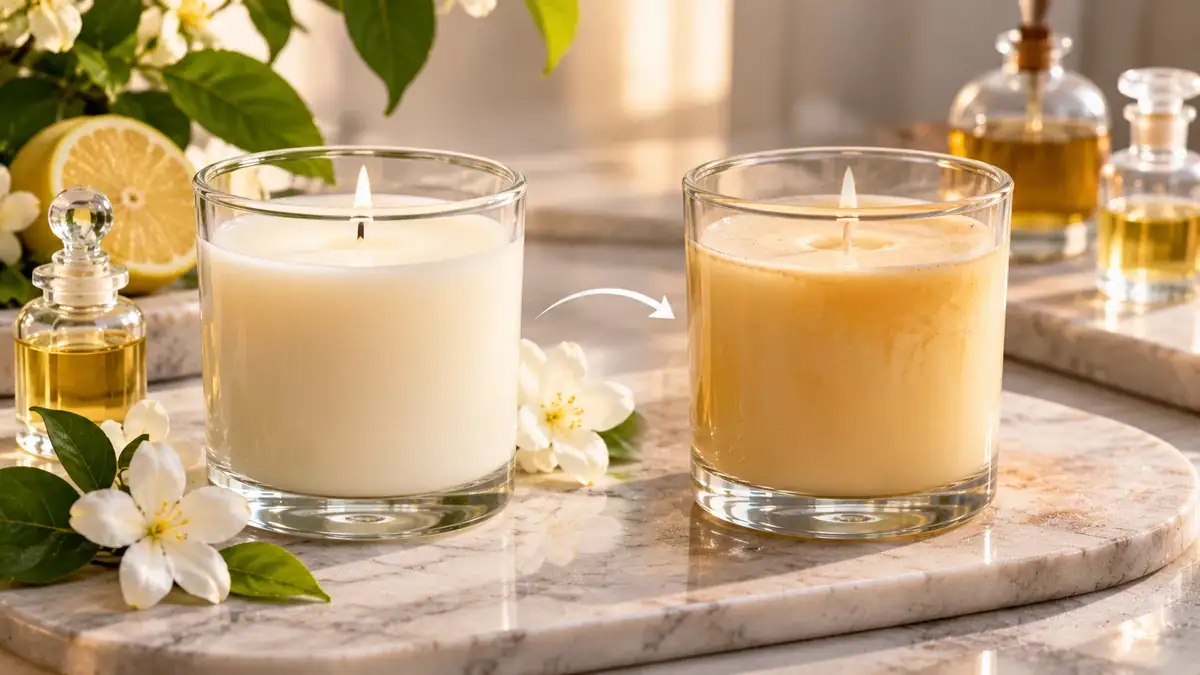
Appearance provides another clue with similar limits. Examining why candle wax changes colour shows how oxidative reactions can tint finished candles over time, though colour alone cannot identify which ingredient changed. Light, the original colour of the materials and interactions in the finished mixture can also affect appearance. Conversely, a fragrance can undergo chemical changes without showing an obvious visible difference.
How researchers distinguish chemistry from perception
A controlled study can compare samples from the same starting material under different oxygen exposures while keeping other conditions comparable. The analyst records the exposure conditions and takes measurements at defined intervals. In a complex formulation, comparing samples of the same starting batch helps reduce the chance that a difference was present before the study began.
Laboratories can separate compounds using chromatography and use appropriate analytical methods to identify starting ingredients and products. Tracking the decline of one ingredient alongside the appearance of chemically plausible products is stronger evidence of oxidation than a change in smell alone. Some products require methods chosen specifically for their chemistry, so the absence of a visible peak in one test does not settle every question.
Sensory evaluation answers a complementary question. Evaluators can compare coded samples to see whether a difference is perceptible and describe its character without knowing which sample received more air exposure. The instrument describes what changed chemically. The evaluators describe what reached them as an odour. Together, these observations help explain why a measurable chemical change can be obvious in one fragrance and difficult to notice in another.
For makers and fragrance enthusiasts eager to explore raw aromatic materials, scent blending, and storage best practices in person, joining a guided candle making workshop in Dubai provides hands-on experience in formulating balanced, stable candles.
Key Takeaways
- Fragrance oxidation alters molecular structure: Unlike simple fading, autoxidation consumes original aromatic molecules and creates new chemical compounds.
- Radical chain reactions drive autoxidation: Exposure to air and light initiates free radicals that form hydroperoxides, aldehydes, and ketones over time.
- Ingredient structure dictates stability: Compounds like linalool and limonene react at different rates regardless of whether they are naturally extracted or synthetically produced.
- Evaporation and oxidation act separately: Evaporation moves intact molecules into the air, whereas oxidation chemically transforms the liquid left behind.
- Lab testing and sensory panels complement each other: Chromatography identifies exact chemical shifts, while blinded human evaluation measures how those shifts alter perceived scent.
Frequently Asked Questions
Does opening a fragrance start oxidation immediately?
Opening can introduce fresh air, but the rate and extent of any reaction depend on the material and conditions. Oxygen may also have been present in the container already. The first opening is rarely a reliable timestamp for the start of a measurable change.
Does oxidation always make a fragrance weaker?
The overall scent can become weaker, stronger in certain aspects, or simply different. A familiar ingredient may diminish while other ingredients or reaction products become more noticeable. Perceived strength depends on the blend and how it releases vapour.
Is oxidation the same as fragrance evaporation?
Evaporation is a physical change in which molecules enter the gas phase. Oxidation is a chemical change that produces different molecules. Both can alter the smell of a blend after exposure to air.
Do all fragrance ingredients oxidise at the same rate?
No. Molecular structure, oxygen availability and the surrounding mixture influence the rate. Even the same ingredient can behave differently in a concentrated sample and in a finished product.
Can a darker fragrance prove it has oxidised?
A darker colour can prompt closer investigation, but it cannot establish the cause. Comparison with an appropriate reference and targeted chemical analysis provide better evidence.
Does lighting a candle demonstrate fragrance oxidation?
A burning candle involves combustion, heating and the release of fragrance compounds. Those processes differ from studying how an ingredient changes under air exposure at ordinary temperatures. The odour of a lit candle alone cannot establish whether its fragrance ingredients had previously oxidised.
Fragrance chemistry reference: Sköld and colleagues on linalool autoxidation
About Studio Kinza
Studio Kinza is a Dubai-based artisanal candle studio located in Warsan, International City, crafting clean-burning handcrafted soy candles from non-toxic botanical waxes and fine fragrance oils. Through hands-on workshops, masterclasses, and educational guides, we explore the science behind candle materials, scent, and combustion.
Plan Your Experience
Curious to explore fragrance chemistry, scent blending, and artisanal wax pouring in a guided studio setting? Contact the Studio Kinza team to reserve workshop seats, arrange private group sessions, or enquire about bespoke candle experiences in Dubai.

Why Candle Flame Is Yellow
Why Is a Candle Flame Mostly Yellow? Understanding Incandescence The...
Read More
Candle Flame Without Gravity
Can a Candle Flame Exist Without Gravity? What Space Experiments...
Read More