Why Can You Sometimes See a Candle Flame in Daylight?...
Read MoreCan a Candle Flame Exist Without Gravity? What Space Experiments Reveal
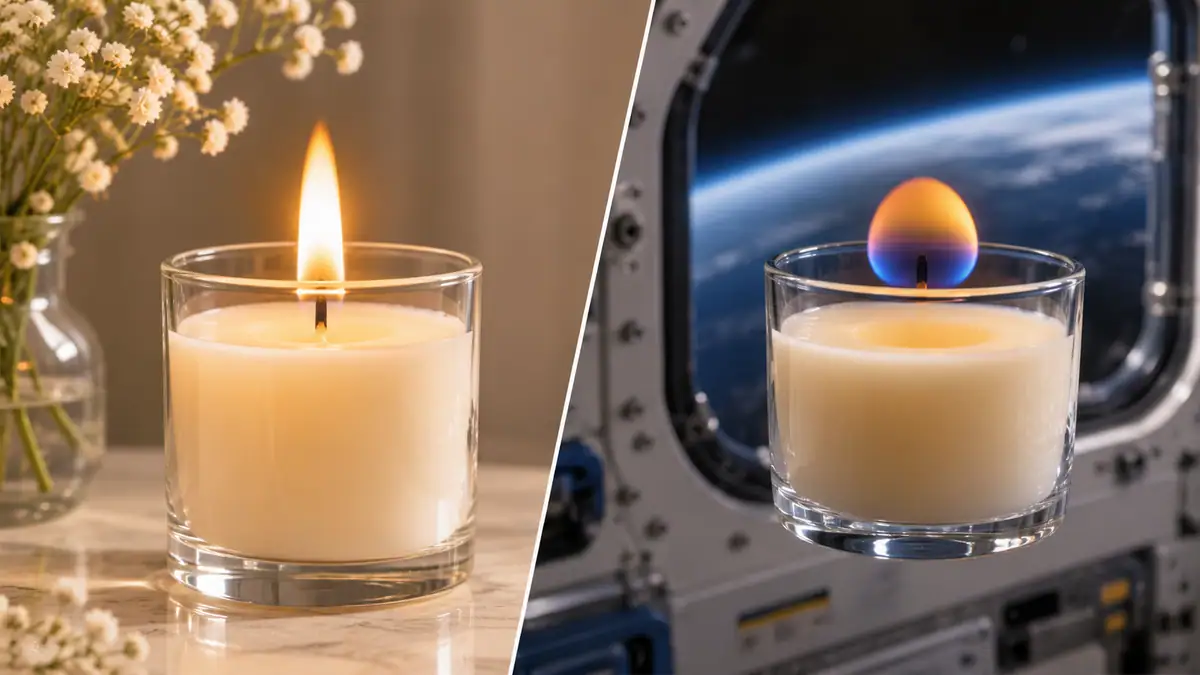
A candle can burn in microgravity when it has fuel, oxygen and enough heat to sustain the reaction. In controlled experiments aboard the Space Shuttle and the Mir space station, researchers observed candle flames that were small, dim and roughly hemispherical after an initial transition. Some Mir trials lasted up to 45 minutes. That was an experimental result under particular conditions, far removed from what would happen to a candle exposed to the vacuum outside a spacecraft.
The familiar shape of a candle on Earth depends on an upward current generated by the flame itself. Heated gases rise through cooler surroundings and fresh air moves in. In an orbiting laboratory the candle and the air around it are in free fall together, greatly reducing that buoyant circulation. Oxygen can still reach the flame, but it follows a different pattern.
Comparing the two settings shows how much of the familiar appearance of fire comes from the movement of gases. Gravity influences where the hot gases go, how quickly oxygen arrives and how combustion products leave. The chemical reaction can continue even when those flows change substantially.
What researchers mean by microgravity
A spacecraft in orbit is still affected by Earth’s gravity. Gravity keeps the spacecraft in orbit. The objects inside, along with the spacecraft itself, are continually falling together around Earth. An object placed on a scale inside the spacecraft would exert very little apparent weight in ordinary free fall. This is the setting researchers describe as microgravity.
The air in an experiment is also in free fall. On Earth, a warm parcel of gas and a cool parcel respond differently to the surrounding pressure gradient. The warm parcel is less dense and rises relative to the cooler air. In the freely falling experiment the ordinary gravity-driven separation is greatly reduced. There is no strong reason for the hot gases to make the same upward plume seen above a candle on Earth.
Other forces and sources of movement can still matter. A fan moves air mechanically. A spacecraft can have small accelerations, and a test chamber can have walls that affect the gases inside it. Researchers therefore describe the conditions of a particular experiment rather than treating all situations in orbit as perfectly still.
How the Earth flame gets its pointed shape
On Earth, wax supplies fuel vapour close to the wick. Oxygen arrives from the surrounding air. The reaction releases heat, which warms the gases. Those hot gases rise in a plume and cooler air moves in from the sides. Examining why a candle flame is teardrop shaped illustrates how this buoyancy-driven upward flow stretches the visible flame into its familiar pointed silhouette.
The wick supplies a starting point for the flame, but the air determines much of what happens above it. If you rotate an image of a candle, the flame may appear to point sideways on the screen. In the original room, the direction is tied to the movement of gases relative to gravity and to any local drafts. The orientation of the picture is separate from the cause of the shape.
The rising flow also changes how materials are transported. Hot gases can carry soot particles upwards while oxygen arrives around the outside. Some of those particles glow yellow. A bright upper region can therefore reflect the journey of hot particles as well as the distribution of gaseous reactions. Change the transport and you can change both the outline and the light the flame gives off.
How oxygen reaches a flame when buoyancy is weak
Diffusion supplies oxygen
Gas molecules move continually. If oxygen is more concentrated outside the reacting zone than within it, random molecular motion produces a net movement of oxygen towards the lower concentration. This process is diffusion. It happens on Earth too. In quiet microgravity conditions it becomes especially important because the strong upward circulation familiar on Earth is absent.
Fuel vapour also spreads away from the wick. Understanding what actually burns in a candle clarifies how vaporised wax molecules mix with surrounding oxygen rather than the solid wick itself burning away. At some distance from the fuel source, enough fuel and oxygen can meet to sustain reactions. Around a small source in still air, that mixing can occur in several directions rather than being strongly stretched upwards. The candle body and wick still occupy space on one side, which helps explain why researchers often describe the observed shape as hemispherical rather than a perfect free-floating sphere.
Products have to move away as well
Combustion produces gases that move away from the flame. On Earth the upward plume provides an efficient route. In quiet microgravity those gases spread differently. Their presence affects the local mixture, and energy can leave the reacting zone by heat transfer and radiation. The flame can persist only while the combined supply of reactants and the balance of heat support it.
Think of the flame as a region exchanging material with its surroundings. Oxygen comes in, fuel comes from the wick, and combustion products leave. Gravity changes some of the routes and rates. The chemical need for oxygen and fuel remains in place throughout.
What the Shuttle and Mir experiments observed
NASA’s technical reports describe experiments in relatively quiet microgravity aboard the Space Shuttle and Mir. In the Shuttle observations, yellow light was visible in an initial period. The flame then became dim and blue. The longer-duration experiments showed that a candle could maintain a near-steady flame under suitable conditions, rather than simply producing a rounded flash during a few seconds of free fall.
The Mir observations included flames that persisted for as long as 45 minutes. The report also describes yellow luminosity persisting longer in the Mir tests and associates that with a higher initial oxygen concentration. This matters because it shows that a round, dim blue flame is an observation with a context. The same candle system can show different colours over the course of an experiment, and differences in the starting atmosphere can change what the observers see.
The duration describes selected trials in controlled equipment. It does not give a typical burn time for a candle on Earth or a prediction for another chamber. In a different enclosure, oxygen availability, gas exchange or heat transfer can change the outcome. Scientists use these details to determine whether two experiments are comparable.
Why the colour can be different
A bright yellow candle flame on Earth owes much of its visible light to hot soot particles. Exploring why candles produce black soot explains how incandescent carbon particles form in fuel-rich zones and emit golden-yellow light as they heat up. The strength of the yellow glow depends on how many particles form, where they travel, how long they remain hot and whether they are oxidised before leaving the flame.
A dim blue appearance in a microgravity experiment means that the yellow contribution is much less prominent at that stage. Light from excited species involved in the flame reactions can then be easier to see. The photographs and reports describe an observed change in luminosity. They cannot be used as a universal rule that all flames in orbit are blue or that a blue appearance reveals one precise temperature.
This is a useful case where brightness and chemistry must be interpreted together. A camera that shows the blue edge clearly may make the flame look more visually prominent than it would appear to a person in a brightly lit laboratory. The recorded shape and the apparent intensity also depend on the exposure and viewing setup. Researchers can report the outline and timing while using other measurements to understand what caused them.
Why an orbital laboratory gives a different answer from a short drop
A falling experiment can briefly reduce the effective weight of its contents. That is useful for seeing a transition away from the familiar Earth flame. The observation period is short, so some of the yellow light or hot gases you see may still reflect the state the flame had before the drop. A rapid change in shape and a flame that holds a new shape for many minutes are different kinds of evidence.
A long orbital experiment gives the gases, wick and flame more time to adjust. Researchers can observe an initial stage, a period of relatively steady behaviour and changes before extinction. Comparing those stages can show whether a colour or shape belongs to a settled pattern or only to the transition. That distinction helps when photographs from different experiments appear to show different results.
An illustration of a spherical flame is therefore best read alongside a caption giving the method and timing. Ask whether the flame was lit before free fall, how long the low-gravity period lasted and whether air was deliberately moved. Those questions help explain why the demonstration looks the way it does without assuming that every experiment in reduced gravity should match it exactly.
What this tells us about fire inside a spacecraft
Inside a spacecraft, ventilation moves air. A flame in moving air can behave differently from a flame in the deliberately quiet environment of a candle test. Researchers can change the airflow or the atmosphere in specialised equipment to examine particular effects. They study combustion in such settings because the transport of heat, oxygen and smoke matters for spacecraft fire safety.
Outside a spacecraft, a candle would face a very different environment. A vacuum provides essentially no surrounding oxygen to support an ordinary candle flame—much like the oxygen-starved principles illustrated when exploring why a candle goes out under a jar. An engine or other specialised system can burn fuel in space if it carries an oxidiser. The distinction is about the reactants available to the flame. Microgravity describes the motion of the laboratory, while vacuum describes the absence of a surrounding atmosphere.
Candle experiments are valuable because they make the role of flow visible in a familiar system. A single flame lets researchers compare what happens when buoyancy is strong with what happens when it is weak. That comparison does not recreate every spacecraft fire scenario. It isolates one influence so that more complex experiments can be understood more clearly.
Why oxygen concentration belongs in the caption
Two images may both be labelled candle in microgravity while showing different amounts of yellow light. The label names the environment but omits the starting gas mixture. NASA’s report connects a longer period of yellow luminosity in the Mir observations with a higher initial oxygen concentration. A useful comparison preserves that detail along with the time since ignition. Otherwise, a picture of the initial transition could be mistaken for a picture of the later, steadier flame.
Key Takeaways
- Candles can burn in microgravity when oxygen is present: Orbiting spacecraft cabins supply breathable air, whereas the vacuum outside a spacecraft cannot sustain an open flame.
- Free fall eliminates buoyant upward convection: Because warm and cool air fall together in orbit, hot gases do not rise to stretch the flame into a teardrop.
- Molecular diffusion feeds the microgravity flame: Without rising air currents, oxygen slowly diffuses inward from all directions while combustion products spread outward.
- Space flames appear dim, rounded, and blue: Reduced soot formation diminishes golden-yellow incandescence, revealing a faint blue hemispherical reaction zone.
- Atmosphere and airflow dictate duration: Controlled Mir experiments sustained steady flames for up to 45 minutes depending on oxygen concentration and chamber ventilation.
Frequently Asked Questions
Can a candle burn in the vacuum of space?
An ordinary candle needs an oxidiser, normally oxygen in the surrounding air. The vacuum outside a spacecraft does not provide that supply. The documented experiments took place in controlled equipment with a surrounding atmosphere.
Does microgravity remove gravity from the spacecraft?
Gravity remains important and keeps an orbiting spacecraft on its path. The spacecraft and its contents fall together, so the contents have very little apparent weight. That greatly reduces the buoyancy-driven flow seen in a room on Earth.
Why does the flame look rounded?
Without strong upward convection, fuel and oxygen can spread and meet around the wick in several directions. The candle body and test conditions influence the outline. Researchers often describe the flame as hemispherical.
Why was there yellow light at first?
The observations included an initial period with yellow luminosity before the flame became dimmer and bluer. The distribution of hot soot and the evolving conditions around the wick can affect that transition. The initial oxygen level can also influence how long the yellow light persists.
Do all space candle experiments last 45 minutes?
That figure was an upper duration observed in some Mir trials. Other trials and designs can have different durations. The value belongs to the conditions and samples reported by the researchers.
What happens if a fan runs near the flame?
A fan produces forced airflow even in microgravity. It can transport oxygen, heat and combustion products and change the shape of the flame. A test with forced flow is different from the quiet conditions used to study diffusion.
References: NASA Shuttle and Mir candle flame report • NASA on studying flames in space
About Studio Kinza
Studio Kinza is a Dubai-based artisanal candle studio located in Warsan, International City, crafting clean-burning handcrafted soy candles from non-toxic botanical waxes and fine fragrance oils. Through hands-on workshops, masterclasses, and educational guides, we explore the science behind candle materials, scent, and combustion.
Plan Your Experience
Curious to explore combustion science, wick sizing, and custom fragrance blending in a guided studio setting? Contact the Studio Kinza team to reserve workshop seats, arrange private group sessions, or enquire about bespoke candle experiences in Dubai.

Why Candle Flame Is Yellow
Why Is a Candle Flame Mostly Yellow? Understanding Incandescence The...
Read More
Candle Flame Without Gravity
Can a Candle Flame Exist Without Gravity? What Space Experiments...
Read More