Why Does a Candle Wick Turn Black During Burning? A...
Read MoreWhat Actually Burns in a Candle: The Wax, the Wick, or the Vapour?
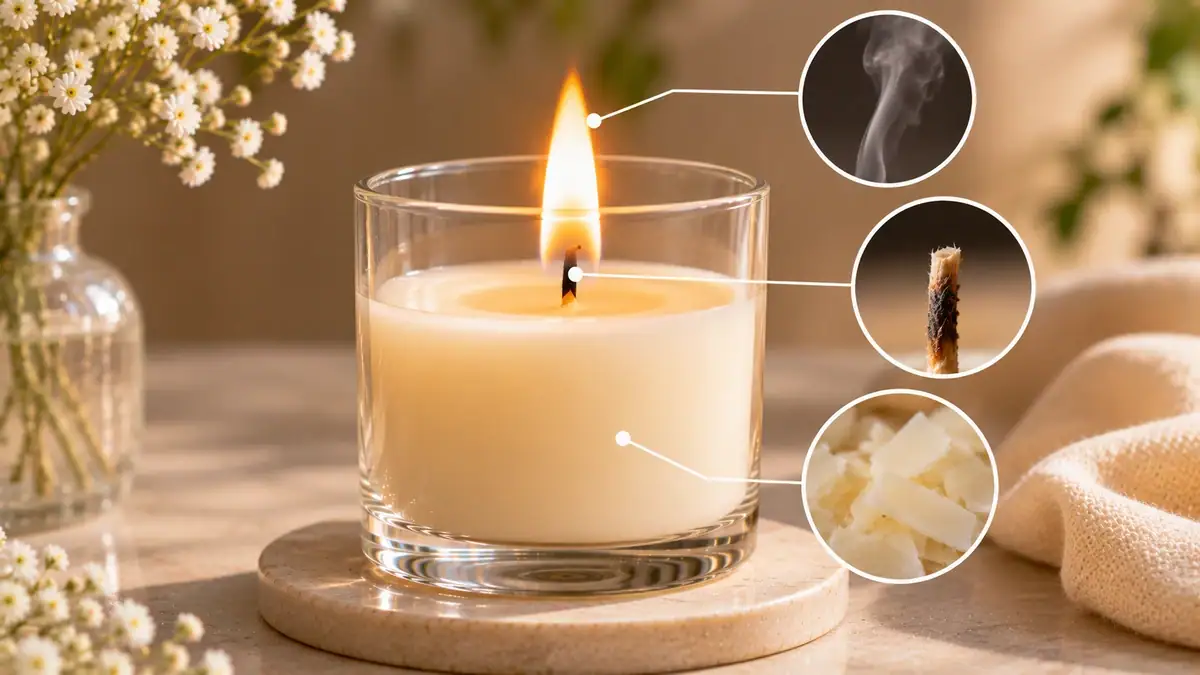
When a candle burns, most of the fuel comes from the wax, and most of the flame’s chemical activity takes place in the gases above the wick. The solid wax you see in the jar is a reservoir. Heat turns some of it into liquid and then releases wax-derived vapour near the flame. That vapour mixes with oxygen and reacts, releasing the energy that keeps the process going.
The wick has a different role. It brings liquid fuel to a small, hot region where that fuel can enter the air. The wick itself can char and some of its material can be consumed. That helps explain the black tip left behind, but the wick cannot account for the length of a candle’s burn. A small amount of wick supports the consumption of a much larger amount of wax.
Following the same material from the solid candle to the gas above the flame makes the process easier to picture. Along the way, melting and vaporisation change its physical state. Combustion then changes its chemical identity.
The solid wax is the fuel supply
At room temperature, the body of an ordinary candle holds its shape because the wax is solid. Lighting the exposed wick gives the system enough heat to begin. Initially the heat can come from a match or lighter. Once the candle is established, part of the energy released by its own flame warms the nearby wax. Understanding why candle wax melts and the science of candle making clarifies how radiant heat builds a small pool of liquid at the surface.
Melting changes how the wax behaves without necessarily changing its molecules. A drop from an extinguished candle can cool and become solid again. It has changed state twice. This is different from the fate of material that has passed through combustion and formed new compounds. You can recover some of the melted wax by cooling it, while ordinary cooling cannot turn combustion products back into candle wax.
The fact that a candle can leave a pool or a solid rim behind illustrates the distinction. Material can receive enough energy to melt and still remain in the vessel. Only a portion makes the journey from the pool to the hot zone and ultimately into the reacting gases. How much remains depends on the candle’s design and how far it has been used.
Why fuel enters the flame as vapour
A flame is a region of hot reacting gas. The wax is supplied as liquid near the wick, where it encounters a much hotter environment than the liquid pool as a whole. Some fuel enters the gas phase. Heat can also break some large wax molecules into smaller fragments. The resulting mixture contains combustible gases that can react when they encounter oxygen.
Vaporisation and thermal breakdown are related but distinct. When a molecule vaporises, it enters the gas phase. When a molecule breaks down, its structure changes. A real candle involves both physical and chemical steps, which is why a diagram showing a single arrow from liquid wax to flame is a useful simplification. It leaves out the variety of molecules and fragments that may be present.
The pool need not be visibly boiling for fuel to reach the flame. Most of the pool is cooler than the small region near the exposed wick. Different parts of the candle can be doing different things at the same time. Wax farther away can remain solid, wax near the surface can be liquid, and fuel near the flame can become gas. The candle works because these regions coexist and supply one another.
The vapour itself can be difficult to see. Much of what the eye notices comes from light emitted in the reaction zone and from hot particles that can glow inside the flame. Seeing a yellow shape therefore tells you where light is being produced. It gives only an indirect view of the fuel on its way to that region.
Where fuel and oxygen meet
The fuel comes from the wick region, while most oxygen arrives from the surrounding air. Scientists call this a diffusion flame because the fuel and oxidiser start apart and mix as the flame operates. Examining candle flame temperature zones illustrates how uneven oxygen mixing creates a cooler, fuel-rich inner core surrounded by a bright yellow zone and a hot outer reaction edge. The places where they meet in suitable proportions and stay hot enough are especially important for combustion. The whole visible flame is not a uniform mixture.
Near the wick, the gases can be relatively rich in fuel. Farther out, the flame has greater access to oxygen from the room. In the hot, fuel-rich region, reactions can make fragments and tiny carbon-rich particles. Some particles emit the familiar yellow light as they heat up. When they move into regions with more oxygen, they can be oxidised further. A candle’s visible colour is therefore tied to how its fuel and oxygen are distributed.
Even a small flame involves many intermediate reactions. At the level of an introductory chemistry lesson, it is useful to say that wax-derived fuel reacts with oxygen and releases energy. For a hydrocarbon fuel undergoing complete combustion, carbon dioxide and water are the main final products. Real flames can also produce intermediate compounds and particles, especially where oxygen supply or mixing is uneven. A balanced equation describes an ideal overall reaction and leaves the route between starting materials and final products to a more detailed explanation.
What the wick contributes
The wick holds fuel in a narrow space near the flame. Exploring how candle wicks draw liquid wax clarifies how capillary forces lift melted fuel upward into that narrow vaporisation zone. That gives the candle a steady place to release vapour. If you compare the candle to a small lamp, the wax is the stored fuel and the wick helps feed it to the burner. The candle itself also provides much of the heat needed to maintain that delivery once it is lit.
The exposed wick is made of material that responds to heat. It can dry, darken, break down and char. Some of it can react with oxygen. Its appearance after a burn therefore reflects a mixture of changes to the wick itself and material that may have collected on it. Those effects are visible at the tip, while the bulk of the fuel has travelled into the flame as wax-derived gas.
A candle that loses its wick has also lost the ordinary route by which fuel reaches its hot region. A pool of liquid wax elsewhere in the jar cannot simply take over that arrangement. The flame depends on the wick’s position relative to the wax and the air. That dependence explains why the wick matters so much even though wax supplies most of the energy.
How the flame keeps supplying its own fuel
A lit candle maintains a feedback loop. Combustion releases heat. Some of that heat reaches the wick and the wax, producing more fuel vapour. The vapour reaches the hot gases and reacts with incoming oxygen. In a steady burn, these steps continue at rates that are broadly compatible with one another.
The feedback can weaken. If a strong puff cools and displaces the hot gases, reactions can slow enough that the flame goes out. Understanding why candle smoke rises after blowing out a candle shows how residual wick heat continues releasing unburned wax vapour briefly after active flaming stops. As the remaining heat dissipates, the release of material declines. The plume is an observation about the cooling candle and can appear after active flaming has already stopped.
Limiting oxygen can interrupt a different part of the loop. Fuel may still be present, but the reaction cannot release enough heat to sustain itself if the local oxygen supply becomes too limited. This helps explain why a candle can go out while a substantial amount of wax is still available. Having fuel in reserve is only one condition for burning.
What changes in mass can tell you
A candle gets lighter over time because material leaves the candle assembly. Some of that material becomes gases that disperse in the room. In a candle test, the assembly can be weighed once cool before and after a defined burn. A mass difference tells you how much the assembly lost over that interval, provided you account for changes such as removed wick trimmings or spilled wax.
A balance under the cooled candle does not weigh all the products of the reaction. Some oxygen from the air became part of those products. To account for the total mass of a chemical reaction, you would have to include the oxygen and the products that leave the flame as well as the starting fuel. The apparent disappearance of wax from a jar is an observation about the candle’s boundary. The material becomes dispersed in forms that the original weighing setup does not capture.
Here is a useful thought experiment. Imagine that a candle loses several grams while its wick shortens only slightly. The comparison suggests that the wick could not have supplied most of the lost material. You would need separate measurements to account for every gram, but the observation fits the picture of a large wax reservoir feeding a small flame. Any classroom measurements should use a supervised procedure and allow the candle to cool before handling.
How to read a candle flame diagram
Start by locating the wick and the liquid wax. Then find arrows showing fuel moving upward and oxygen arriving from the sides. The arrows represent different ingredients moving towards the reacting region. A third arrow often shows heat returning towards the wax. That return path explains why the flame can sustain itself after the match is removed.
Diagrams often use clean bands of colour to make the ideas legible. In a real flame the boundaries shift, and the reactions are distributed across regions that interact. A diagram can help explain where oxygen and fuel are likely to meet. To interpret a photograph, also consider exposure and the fact that the visible light highlights some regions more strongly than others.
There is also a difference between a diagram of a candle and a diagram of a gas stove. The stove receives fuel that is already gaseous at the burner. The candle has to prepare its fuel from a solid store as it operates. Compare where the energy comes from in each drawing and where the fuel first meets oxygen. The comparison shows why the small region immediately around a candle wick is so important. Its heat both supports the reactions nearby and transforms material for the next moment of burning.
Why a wider melt pool does not tell you how much wax has burned
A wide pool shows that heat has reached more of the wax surface. It does not measure how much fuel entered the gas phase. Two candles may have similar pools and different mass losses because their wicks deliver different amounts of fuel to the hot region. Likewise, a candle can continue burning as the edge of its pool moves very little. For a meaningful comparison, use the pool as evidence of where melting occurred and a cold before-and-after weight as evidence of how much material left the candle assembly. Those observations describe different stages of the same process.
Key Takeaways
- Wax vapour is the true fuel: Solid wax melts into liquid, vaporises near the hot wick, and reacts with airborne oxygen to produce the visible flame.
- The wick acts as a fuel pump, not the main fuel source: Capillary action draws liquid wax into the heat zone while only the exposed wick tip chars slowly.
- Candle flames operate as diffusion flames: Fuel vapour rises from the centre while oxygen diffuses inward from the surrounding room air.
- A self-sustaining thermal loop keeps the candle lit: Radiant heat from combustion continuously melts and vaporises fresh wax until fuel, heat, or oxygen runs low.
- Cold mass loss measures true fuel consumption: Melt pool width only reflects surface heat spread, whereas weighing the cooled candle tracks actual vaporised wax.
Frequently Asked Questions
What actually burns in a candle?
Most of the flame is sustained by wax-derived vapour and gases reacting with oxygen. The solid candle serves as the fuel reservoir. Heat prepares the wax for combustion by melting it and releasing gaseous fuel near the wick.
Does the wick burn too?
The exposed wick can undergo thermal breakdown, char and be partly consumed. Wax still provides most of the fuel during a normal burn. The wick’s shape and position help the candle deliver that fuel where it is needed.
Is melted wax already burning?
Melted wax has changed from a solid to a liquid. Much of the liquid can cool and solidify again. The familiar visible flame occurs mainly where wax-derived gases meet oxygen and react.
Why does a candle leave wax behind?
Some wax never reaches the hot fuel supply region. It can remain around the walls or below the candle’s designated stopping point. The amount left depends on the vessel, wax and wick arrangement as well as how the candle was used.
Where does the missing wax go?
Much of the consumed fuel ends up in gases, including carbon dioxide and water vapour. Depending on flame conditions, some material may also leave as other compounds or particles. The products spread into the air.
Why does the flame go out if there is still wax?
The flame needs a continuing supply of gaseous fuel, enough oxygen and enough heat to sustain the reactions. Interrupting any of those conditions can stop the flame while solid or liquid wax remains.
References: NASA on candle flame energy and fuel
About Studio Kinza
Studio Kinza is a Dubai-based artisanal candle studio located in Warsan, International City, crafting clean-burning handcrafted soy candles from non-toxic botanical waxes and fine fragrance oils. Through hands-on workshops, masterclasses, and educational guides, we explore the science behind candle materials, scent, and combustion.
Plan Your Experience
Curious to explore wick sizing, combustion science, and custom fragrance blending in a guided studio setting? Contact the Studio Kinza team to reserve workshop seats, arrange private group sessions, or enquire about bespoke candle experiences in Dubai.

Why Candle Smoke Rises After Extinguishing
Why Does Smoke Rise from a Candle Just After You...
Read More