

Why Does Candle Wax Shrink as It Cools? The Science...
Read MoreWhy Is a Candle Flame Shaped Like a Teardrop?
Why does this happen? The answer becomes clearer when we examine what happens to materials and energy rather than relying on how a candle looks at first glance. Everyday candle observations provide a surprisingly accessible introduction to physics and chemistry, but a familiar appearance can have more than one cause.
This Studio Kinza guide explores why candle flame is teardrop shaped for curious readers, students and hobby makers. It follows the mechanisms involved, explains which conclusions are reasonable, and separates useful observations from claims that would require controlled measurement. The aim is understanding rather than a shopping guide or a universal recipe.
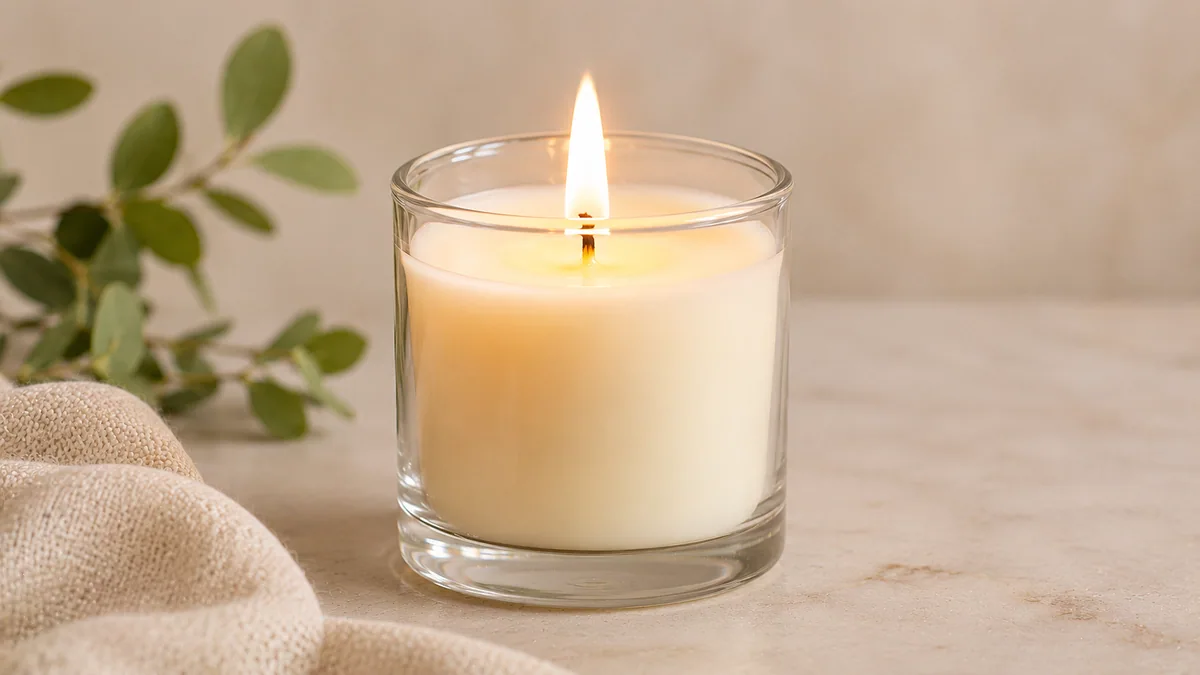
The role of gravity
On Earth, hot combustion gases are usually less dense than the cooler air around them. Buoyancy makes the hot gases rise. This rising flow stretches the luminous region upward and helps create the familiar teardrop silhouette.
To understand this point, pay attention to the sequence of events rather than only the final result. Ask what changes first, what must be present for the process to continue, and which surrounding conditions could alter what you see. In the context of why candle flame is teardrop shaped, that approach is more reliable than attributing every difference to one ingredient or one moment of observation. It also helps distinguish a plausible explanation from something that has actually been measured.
Convection builds the flame shape
As heated gases move up, surrounding cooler air is drawn toward the flame. This circulation is convection. Oxygen enters from the outside while fuel vapour rises from the wick. Understanding why candle wax melts and the science of candle making highlights how this continuous thermal cycle sustains a steady liquid fuel pool beneath the flame. The interaction between upward flow and mixing shapes the flame’s outline.
Why the flame is wider near its base
Fuel vapour emerges near the wick and mixes with incoming air. Exploring how candle wicks draw liquid wax clarifies how capillary action feeds molten wax upward to vaporise right at the combustion zone. The flame’s visible zone depends on where combustion products and glowing particles form. The lower region can appear broader as fresh gases and surrounding oxygen meet before the upward flow narrows the plume.
What the bright yellow region means
The yellow light of many candle flames is associated with tiny hot soot particles glowing before they oxidise or leave the flame. Not every part of the flame has the same composition or temperature. Colour alone is not a precise thermometer.
The shape changes with airflow
A sideways current pushes and bends the hot gases, often making the flame lean. Even subtle ventilation can distort the ideal teardrop. Reviewing common candle mistakes and how to avoid them helps makers prevent excessive flickering and uneven burning caused by air drafts or untrimmed wicks. A still-air sketch is a simplified model, not a promise that every real flame looks perfectly symmetrical.
What happens in microgravity
When buoyancy-driven upward flow is greatly reduced, a flame can become more rounded because gas movement and oxygen delivery differ. Experiments in microgravity have shown flame shapes unlike the tall terrestrial teardrop. The difference illustrates the importance of gravity rather than a change in the basic need for fuel and oxygen.
Diffusion and mixing
Oxygen must move from the surrounding air toward fuel-rich regions. Molecular diffusion and bulk gas motion both contribute. Combustion occurs where the mixture and temperature support reaction. That is why the visible edge is not simply a rigid shell around a burning wick.
A diagram you can draw
Draw a wick at the bottom, an upward arrow through the flame for buoyant gases, and inward arrows from each side for incoming air. Add a curved outline that narrows toward the top. Label it a simplified side view; real flames fluctuate in three dimensions.
Why a photograph may mislead
Exposure settings, shutter speed and white balance affect how much of the flame is visible. A short exposure may freeze an irregular contour, while a long exposure can blend movements into a smoother shape. Photographs are useful observations but not complete flow measurements.
A safe way to observe
From a normal viewing distance, compare a flame in a quiet room with its appearance when ordinary ventilation changes. Do not blow toward the flame or place objects near it to provoke movement. Observe only with adult supervision where appropriate and extinguish the candle before leaving.
How to interpret the observation
A useful scientific explanation begins with what can actually be observed, then asks which physical or chemical processes could produce it. Avoid assuming that a single visible feature reveals the entire system. Candle behaviour involves materials, heat, surrounding air and time, so one observation often has several plausible contributors.
What changes between real candles
The details depend on wax composition, wick structure, vessel dimensions and environmental conditions. For example, examining why wooden candle wicks crackle demonstrates how flat wooden strips produce wider, ribbon-like flames compared to standard braided cotton. Small differences in these inputs can change the outcome without changing the underlying scientific principle. This is why a mechanism can be well understood while its exact appearance varies from candle to candle.
Common misconception to avoid
An attractive or familiar description can conceal an incorrect causal explanation. Separate a useful analogy from a literal mechanism, and do not infer safety, performance or chemical composition from appearance alone. When a claim would require measurement, treat it as a hypothesis rather than a proven conclusion.
How to think about evidence
Reliable comparisons keep conditions as similar as possible and record more than one observation. Temperature, ventilation, lighting and timing are easy to overlook. A photograph or one brief burn can illustrate a phenomenon, but it rarely establishes a universal rule for every candle.
Five Key Takeaways
- The role of gravity: On Earth, hot combustion gases are less dense than cooler surrounding air, causing buoyancy to stretch the flame upward.
- Convection builds the flame shape: As heated gases rise, cooler oxygen-rich air is drawn inward from the sides to sustain combustion.
- Why the flame is wider near its base: Rising fuel vapour meets incoming oxygen near the wick before upward airflow narrows the plume into a point.
- What the bright yellow region means: The familiar yellow glow comes from incandescent microscopic soot particles heating up before fully oxidising.
- The shape changes with airflow: Subtle drafts, ventilation, and wick geometry can bend or elongate the symmetrical teardrop profile.
Frequently Asked Questions
What is the simplest explanation of why candle flame is teardrop shaped?
On Earth, hot combustion gases are usually less dense than the cooler air around them. Buoyancy makes the hot gases rise. This rising flow stretches the luminous region upward and helps create the familiar teardrop silhouette.
Is why candle flame is teardrop shaped the same for every candle?
As heated gases move up, surrounding cooler air is drawn toward the flame. This circulation is convection. Oxygen enters from the outside while fuel vapour rises from the wick. The interaction between upward flow and mixing shapes the flame’s outline.
Can I identify the cause just by looking?
An attractive or familiar description can conceal an incorrect causal explanation. Separate a useful analogy from a literal mechanism, and do not infer safety, performance or chemical composition from appearance alone. When a claim would require measurement, treat it as a hypothesis rather than a proven conclusion.
Does the surrounding environment matter?
The details depend on wax composition, wick structure, vessel dimensions and environmental conditions. Small differences in these inputs can change the outcome without changing the underlying scientific principle. This is why a mechanism can be well understood while its exact appearance varies from candle to candle.
Is there a safe way to observe the effect?
Draw a wick at the bottom, an upward arrow through the flame for buoyant gases, and inward arrows from each side for incoming air. Add a curved outline that narrows toward the top. Label it a simplified side view; real flames fluctuate in three dimensions.
What should beginners remember about why candle flame is teardrop shaped?
Reliable comparisons keep conditions as similar as possible and record more than one observation. Temperature, ventilation, lighting and timing are easy to overlook. A photograph or one brief burn can illustrate a phenomenon, but it rarely establishes a universal rule for every candle.
About Studio Kinza
Studio Kinza is a Dubai-based artisanal candle studio located in Warsan, International City, crafting clean-burning handcrafted soy candles from non-toxic botanical waxes and fine fragrance oils. Through hands-on workshops, masterclasses, and educational guides, we explore the science behind candle materials, scent, and combustion.
Plan Your Experience
Curious to explore wick sizing, wax chemistry, and fragrance blending in a guided studio setting? Contact the Studio Kinza team to reserve workshop seats, arrange private group sessions, or enquire about bespoke candle experiences in Dubai.
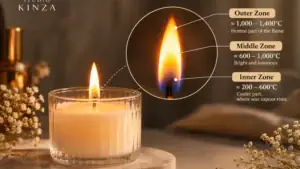
Candle Flame Temperature Zones
How Hot Is a Candle Flame? Understanding Its Different Temperature...
Read More