

How Does Light Direction Change the Appearance of Texture and...
Read MoreEssential Oils, Fragrance Oils and Perfume Oils: What Is the Scientific Difference?
Essential Oils, Fragrance Oils and Perfume Oils: What Is the Scientific Difference? It is a question that becomes easier to answer once we distinguish everyday language from the underlying chemistry and physics. The way aromatic materials and candle wax behave is shaped by composition, temperature, time and the surrounding environment. A simple label or first impression rarely tells the full story.
This Studio Kinza guide explains the science behind difference between essential oils and fragrance oils for curious readers and makers. Rather than presenting a shopping list or a universal recipe, it focuses on mechanisms, observations and practical ways to think critically about what you see or smell. The examples are educational; specific formulas and finished candles still require appropriate supplier guidance and safety testing.
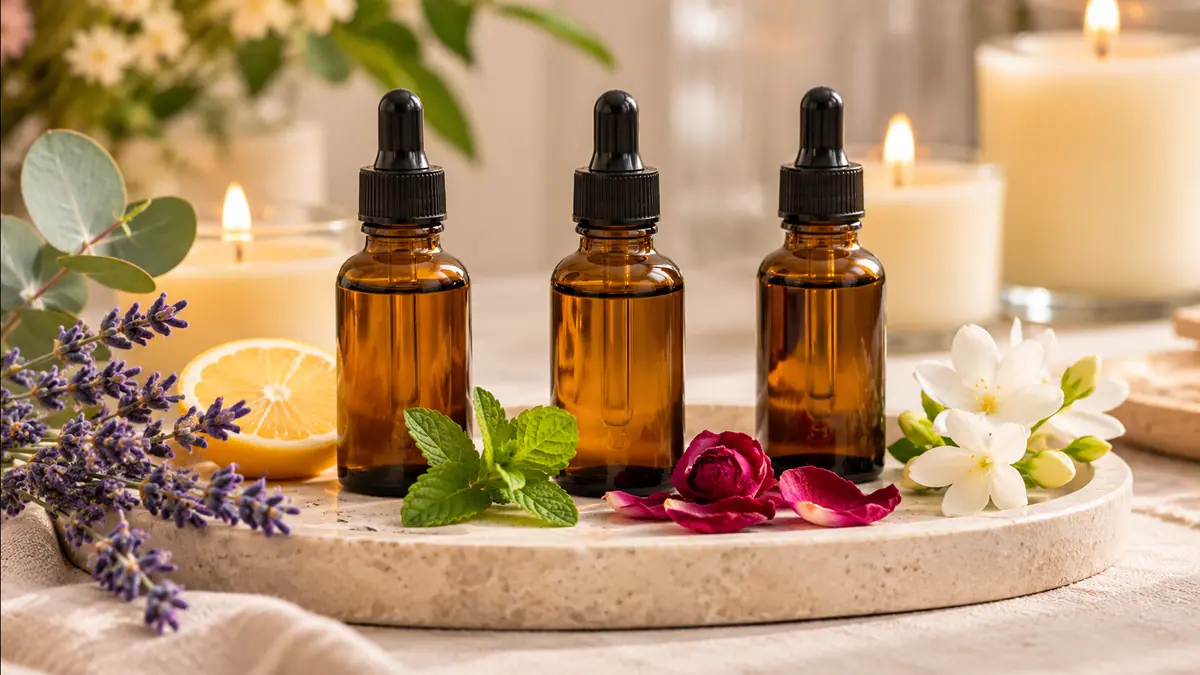
What the three terms actually describe
Essential oil usually means a concentrated volatile aromatic mixture obtained from botanical material by distillation or mechanical expression, particularly citrus peel. Fragrance oil describes a formulated aromatic blend intended to create a particular smell in a specified application. Perfume oil is a less precise consumer term, often used for an oil-based fragrance worn on skin. These labels describe origin, formulation or use rather than three mutually exclusive chemical families.
For a beginner, the key is to separate a visible observation from a proposed mechanism. Ask what changed, which variables were controlled, and whether another explanation fits the evidence. Scientific explanations are strongest when they can be checked rather than repeated as workshop folklore.
How essential oils are produced
Steam distillation carries volatile plant molecules with steam; condensation separates an aromatic oil from water. Citrus oils may be expressed from peels. Extraction method affects the resulting chemical profile, and some botanicals yield absolutes or CO₂ extracts rather than essential oils in the strict sense. Plant variety, harvest, storage and processing can all change the balance of constituents.
Consider the distinction between an ingredient and a finished system. The same material may behave differently when its concentration, surrounding ingredients or temperature changes. This is why isolated facts about a raw material cannot predict every outcome in a completed candle or fragrance.
What is inside an essential oil?
An essential oil is not one pure molecule. It can contain dozens or hundreds of compounds, including terpenes, alcohols, aldehydes, esters and phenols. Limonene can contribute citrus notes; linalool is associated with floral facets; eugenol has a clove-like character. Their relative proportions shape odour, volatility and potential hazards. Natural composition is chemically complex and not automatically consistent between batches.
An accurate explanation should also distinguish what is generally established from what depends on the specific formulation. A supplier may provide practical limits for one material, but those limits cannot be transferred automatically to another product. Documenting the actual materials makes comparisons more meaningful.
How fragrance oils are formulated
A fragrance oil may combine individual aroma chemicals, natural extracts, solvents and carriers. Perfumers select ingredients for an intended sensory profile and for compatibility with the finished application. Some components may be plant-derived, others synthetically manufactured, and many molecules can be produced by either route. A fragrance oil is therefore not necessarily free of natural ingredients, nor is it automatically equivalent to an essential oil.
Think about time as another experimental variable. Some effects are immediate, while others develop gradually under storage or repeated temperature changes. A single photograph taken on the day of manufacture cannot establish long-term stability. Repeated observations provide a more complete picture.
What does perfume oil mean?
Perfume oil commonly refers to a fragrance concentrate diluted in a non-alcoholic carrier for personal use. However, naming conventions vary between brands and markets. A concentrated perfume oil can contain a complex fragrance formula, while a finished roll-on is already diluted. The term alone does not establish ingredient origin, skin suitability or concentration.
A useful way to teach this topic is to compare two carefully controlled samples rather than changing several ingredients at once. Even a small trial can show whether a proposed cause is plausible. It cannot establish a universal rule, but it can prevent conclusions based on coincidence.
Why molecules matter more than marketing labels
Our smell receptors respond to airborne molecules rather than to a label such as natural or synthetic. Two materials with similar key odorants may smell related, while minor compounds change the overall impression. Purity, dose, oxidation and the surrounding formula can also alter perception.
Evaluating the chemical composition of raw materials connects directly to understanding what clean fragrance means in candles, where safety, non-toxicity, and regulatory standards matter far more than simplistic marketing terminology. Chemical identity and exposure conditions are more informative than a simple natural-versus-man-made distinction.
Volatility and stability
Aroma molecules differ in vapour pressure, reactivity and solubility. Highly volatile materials tend to reach the nose readily but can dissipate quickly. Less volatile components may linger. Oxygen, light and heat can change some materials over time.
Exploring the molecular physics of why some smells linger longer than others helps explain how vapor pressure and evaporation rates dictate the lifespan of top, middle, and base notes. This is why the same fragrance formula may evolve in a bottle, a candle or on skin, and why storage and testing matter.
Safety is application-specific
Essential oils can irritate or sensitise, and certain constituents have exposure limits. Fragrance oils likewise need assessment for their intended use. A formula appropriate for a candle is not necessarily suitable for skin, and a skin perfume is not automatically suitable for heating in wax. Safety data sheets, ingredient restrictions and application-specific supplier guidance are more useful than assumptions based on naming.
Reading technical documents
A safety data sheet describes hazards, handling and emergency information; it does not reveal every ingredient or guarantee suitability for all uses. An IFRA certificate, when provided, can indicate usage limits for particular categories, but it must match the exact formulation and intended application. Ingredient declarations and allergen requirements depend on jurisdiction and product category.
Why the distinction matters for learning candle science
In a candle, fragrance ingredients must coexist with wax and remain stable during manufacture and use. Scent performance is influenced by formula, wax, wick, vessel and testing. Essential oil content alone does not predict strong scent throw or safe burning. In wax formulation, calculating fragrance load in candle making ensures the oil binds uniformly into the molten wax without weeping, smoking, or compromising combustion. The scientific question is how the complete system behaves, not which label sounds more appealing.
For makers and scent enthusiasts eager to evaluate how botanical extracts and fine perfume compounds blend in practice, attending a structured fragrance workshop in Dubai provides hands-on experience in note balancing, solvent interaction, and olfactory design.
Five Key Takeaways
- Distinct functional definitions: Essential oils are plant distillates, fragrance oils are formulated aromatic blends, and perfume oils are carrier-diluted personal scents.
- Complex molecular makeups: Pure essential oils contain dozens of volatile botanical compounds whose proportions vary between harvests.
- Molecules surpass labels: Human olfactory receptors respond to specific chemical structures rather than claims of natural or synthetic origin.
- Evaporation rates govern scent lifespan: Differing vapor pressures determine whether an aromatic oil disperses quickly or lingers for hours.
- Safety depends on the specific medium: A material certified for topical perfume use may be completely unsuitable or unstable when burned in candle wax.
Frequently Asked Questions
Are essential oils always natural?
Yes, true essential oils are derived directly from botanical materials through distillation or mechanical expression. However, being natural does not mean they are chemically uniform; each batch contains complex mixtures of terpenes, alcohols, and esters that vary based on climate, harvest, and processing.
Can fragrance oils contain botanical extracts?
Yes. Professional fragrance oils frequently combine isolated synthetic aroma chemicals with natural essential oils and botanical extracts to achieve balanced performance, stability, and depth.
Is perfume oil the same as essential oil?
No. Perfume oil typically describes a finished fragrance blend diluted in a skin-safe carrier oil like jojoba or fractionated coconut oil for personal wear, whereas an essential oil is an undiluted botanical concentrate.
Does natural mean safer?
Not necessarily. Natural essential oils contain potent active constituents that can cause skin sensitisation, phototoxicity, or allergic reactions. Safety depends on concentration, formulation, and intended application rather than whether an ingredient is natural or synthetic.
Can every fragrance be used in candles?
No. Fragrance materials must be formulated to dissolve evenly in molten wax, withstand heat without flashing off prematurely, and burn cleanly without clogging wicks. Many skin-safe perfume oils perform poorly or unsafely when heated in wax.
What documents should a maker check?
Makers should always review the manufacturer’s Safety Data Sheet (SDS) for health hazards and flashpoints, alongside the IFRA Certificate of Conformity to verify safe usage percentages for specific product categories.
About Studio Kinza
Studio Kinza is an artisan fragrance and candle studio based in Warsan, International City, Dubai. We handcraft premium scented soy candles using clean botanical waxes and fine perfumery oils. Through our hands-on workshops, masterclasses, and educational resources, we demystify fragrance chemistry and empower makers with conscious, evidence-based craft techniques.
Plan Your Experience
Ready to dive deeper into the art and science of custom fragrance blending? Contact the Studio Kinza team to book seats in an upcoming workshop, arrange private group sessions, or consult on bespoke scent development for your brand.

How Temperature Affects Smell Perception
How Does Temperature Change the Way We Perceive Smell? A...
Read More
Colour Contrast Candle Label Readability
The Science of Colour Contrast: Why Some Candle Labels Are...
Read More
History Of Beeswax Candles
How Did Beeswax Candles Become Important in Historical Lighting? A...
Read More