Why Can You Sometimes See a Candle Flame in Daylight?...
Read MoreWhy Does a Candle Flame Lean to One Side?
A candle flame usually points roughly upwards in a still room. When the air near the wick moves consistently across the candle, the visible flame can lean to one side. The tilt comes from two motions working together. Hot gases tend to rise through the cooler air around them, while the sideways current carries the gases away from the vertical path.
You can often see the difference between a steady lean and a flicker. A leaning flame has a preferred direction over time. A flickering flame changes shape or position from moment to moment. Both can occur at once. A flame may lean towards the far side of the table while its tip moves back and forth around that position.
The direction gives a clue about airflow at the candle, especially if the wick is upright and the lean persists. Air can turn around a jar rim, a nearby wall or a person standing at the table. The direction at the wick may therefore differ from the direction you would predict by looking at a fan across the room.
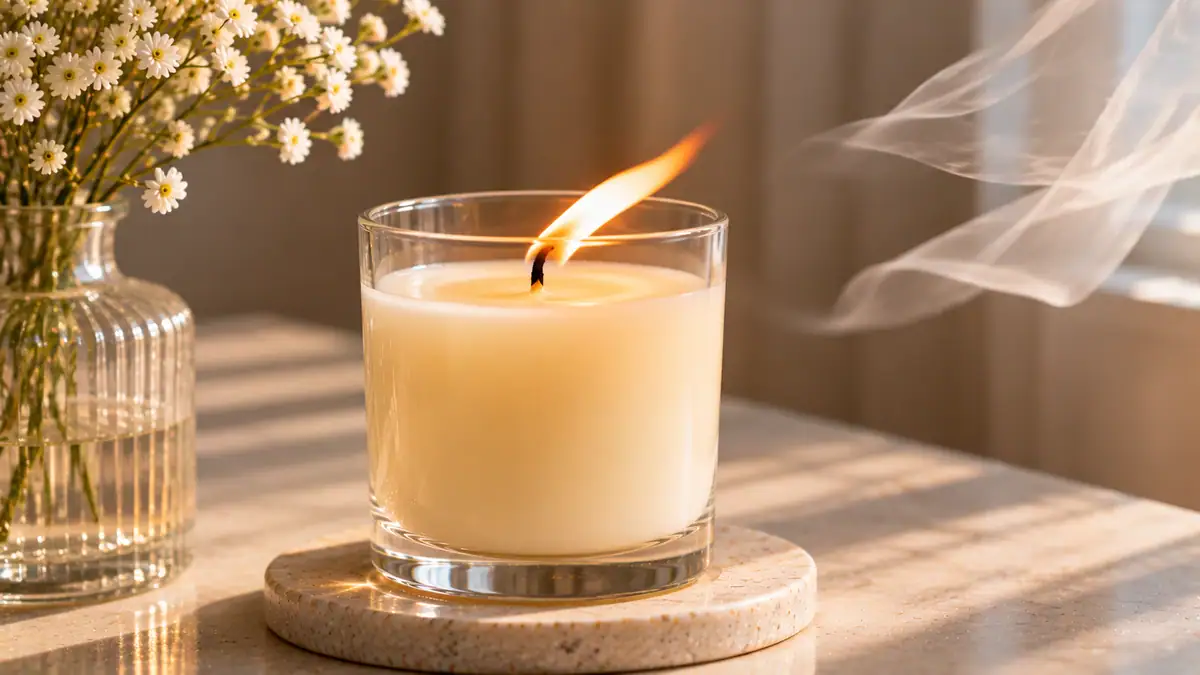
Why a candle flame rises in still air
Combustion releases energy and heats the gases near the wick. At roughly the same pressure, a warmer parcel of gas generally has a lower density than a cooler parcel. Gravity acting on that density difference produces buoyancy. The hotter gases rise relative to the cooler air around them, and surrounding air moves in to replace them.
The upward movement is called buoyant convection. It helps draw oxygen towards the flame from around the sides and carries heated combustion products away above it. This flow is generated by the candle itself, so even a room without a perceptible draft contains moving gas near the flame. Examining why a candle flame is teardrop shaped illustrates how this steady upward current molds the flame into its classic vertical silhouette.
A candle flame has an anchored base because fuel enters the hot region near the wick. The flame above it occupies a volume of reacting gas, and that volume can change shape as the gases move. A vertical wick fixes the approximate starting point of the flame. It cannot hold the rest of the flame upright the way a stem supports a flower.
How sideways flow changes the flame direction
The current carries hot gas downstream
Imagine a gentle air current passing from left to right across a candle. Exploring candle flame airflow science clarifies how incoming room air interacts with the rising thermal column. As hot gas rises from the wick region, the current also transports it to the right. The visible flame stretches and leans in that direction. New fuel continues to arrive near the wick, so the flame appears attached at the base while its upper part is displaced.
If the sideways motion is weak compared with the upward flow, the lean may be slight. If it grows stronger, the displacement can become more apparent. This explains a broad trend rather than supplying a formula for measuring wind speed. Moving air also changes mixing and heat loss, which affect the shape you see. At sufficiently strong or disruptive flow the flame may go out.
The upper part can respond differently from the base. Near the wick, incoming fuel and nearby hot gases help maintain the reaction. Farther up, the current may have more opportunity to move the rising gases sideways. That is why the shape can bend along its length rather than tilt as a straight line. The tip points towards a location that reflects the flow over part of the flame’s height.
The strongest current in the room may be elsewhere
Air from a vent may follow the ceiling before circulating down another part of the room. A table edge can deflect a lower stream. Warm surfaces and cold windows can contribute to circulation as well. Even a draft that feels steady at shoulder height can behave differently closer to the tabletop.
For example, a candle on a shelf might lean towards the wall, even though the nearest visible vent faces across the room. The flame reports conditions within a small region around the wick. Air circulating back along the shelf could explain the apparent mismatch. You would need an independent measurement to establish the route the air took from the vent to the candle.
Why the jar can change the direction
A container can shelter a flame from some direct air movement while also creating local flows around its rim. Air passing across the opening can turn or recirculate near the lip. The flame produces its own warm rising stream inside the container, and that stream meets the air entering from outside. The resulting direction can vary across the opening.
A candle near the start of its life and the same candle later in its life can experience different conditions. As the wax level falls, the flame may sit deeper inside the container. The rim can then shield it from a current that would have crossed a flame near the top. At the same time, the route by which air enters the opening and warm gas leaves may change. The flame’s new position is one reason a comparison should record the fill level or stage of the burn.
Nearby objects can make a similar difference outside the container. A vase, wall or tall place setting changes the space through which air can move. Air can accelerate through a gap or change direction around an edge. These effects do not require a powerful draft. A small flame responds to movement in its immediate surroundings, including movement people may scarcely notice.
What the wick can contribute
A wick that curves or sits off centre changes where fuel enters the flame. Understanding why a candle wick turns black explains how braided cotton fibres curl toward the hotter outer flame edge during combustion. When the tip bends, the visible base and brightest portion can look asymmetric even in comparatively still air. This effect begins at the fuel source, while a sideways current acts on gases around and above it. Both can occur in the same candle.
Once a candle is extinguished and fully cool, look at the wick from more than one angle. A wick that appeared vertical from the front may lean away from the viewer. A photograph that includes the jar rim and the cooled wick gives useful context for a photograph of the flame. A tilted camera or uneven frame can also make a vertical flame look slanted.
Treat wick position as one piece of evidence. If two nearby flames lean the same way while their wick positions differ, shared airflow is one possible explanation. If the lean follows a particular curved wick across several otherwise comparable observations, the fuel geometry may contribute. Neither pattern is enough on its own to identify every cause. Changes in the vessel and the surrounding air can affect the comparison.
How to separate a steady lean from a momentary movement
Watch several seconds of a recording with a vertical reference in view. A jar edge or door frame can help. Identify where the wick enters the flame and trace the broad position of the upper flame across several frames. If it repeatedly extends farther to one side, that is a persistent lean. If it swings around a roughly vertical position, a single frame may exaggerate how directional the movement is.
Next note when the movement begins. A person walking past can create a brief pulse of air. A door opening may produce a stronger change that settles after a moment. A ventilation system can produce a repeated pattern as it cycles on and off. Timing gives context to the angle, particularly when the airflow itself is invisible.
Viewing angle matters as well. A flame leaning towards the camera may look shorter instead of obviously tilted. From a second angle, the sideways displacement can be clear. A photo provides one projection of a three-dimensional shape. For careful observation, two views or a video can clarify a direction that is hard to identify in a single image. Keep any recording equipment clear of the candle and leave the lit vessel in place.
What a candle can and cannot reveal about airflow
A candle makes the interaction between buoyancy and sideways flow visible. That makes it a useful illustration of directional air movement. The angle alone cannot give a reliable speed. A different flame size, wick or container can respond differently to the same flow. The shape also changes as fuel and oxygen mix, so the flame is responding to the flow while generating part of it.
A simple comparison can use existing footage of a candle before and after a nearby door is opened. Identify the direction of the lean, how quickly it begins and whether it stays after the door stops moving. Describe the result in observational terms. Saying the tip moved to the right for several seconds is more precise than claiming a particular wind speed or assuming where every parcel of air came from.
For ordinary use, follow the candle’s care instructions and keep it away from drafts. The National Candle Association recommends a stable, heat-resistant surface and advises against moving a candle while the wax is liquid. If the flame is leaning strongly in a location, extinguish it and let the candle cool before moving it to a suitable spot. Reviewing heat transfer through glass candle containers underscores why a persistent lean toward one glass wall can create an uneven hot spot.
Key Takeaways
- Upward buoyancy meets sideways airflow: A leaning flame reflects the combined push of rising hot gases and a directional air current across the wick.
- Local tabletop currents differ from room vents: Furniture, walls, and jar rims redirect air, causing flames to tilt in unexpected directions even when no breeze is felt.
- Jar depth alters flame shelter: As wax burns down, the container wall shields the lower flame while air recirculates across the upper rim.
- Curved or off-centre wicks add asymmetry: Braided wicks naturally curl at the tip, shifting the flame base even in calm indoor air.
- Persistent leans create uneven vessel heat: Moving a tilting candle—only after extinguishing and cooling—prevents lopsided melting and localized glass overheating.
Frequently Asked Questions
Which way does a candle flame lean in a draft?
It often leans downstream, in the direction the local current is carrying the hot gases. The relevant flow is the flow near the candle. A nearby obstacle or jar rim can turn the air before it reaches the wick.
Can a candle lean when I cannot feel a breeze?
Yes. The flow near a small flame can differ from what you feel nearby. A weak current or air circulating around furniture can create a noticeable tilt. The candle’s own warm plume is also moving while the flame burns.
Can a crooked wick make the flame look tilted?
A curved or off-centre wick can shift the point where fuel enters the flame and create an asymmetric shape. Inspect the wick after cooling, and use a vertical reference when examining photographs of the flame.
Why does a candle lean inside a jar?
The opening can alter how air moves into and out of the vessel. The wick’s distance below the rim and the shape of the jar also influence the local flow. A current outside the jar may behave differently once it reaches the opening.
Is a leaning flame the same as a flickering flame?
Leaning is a persistent directional bias. Flickering is variation in shape, position or brightness over time. A flame can flicker around a tilted position, so the two descriptions can apply together.
Can I estimate draft speed from the angle?
A greater lean can suggest more sideways influence in a comparable setup. The angle also depends on the flame, vessel, viewing direction and buoyant flow. For a quantitative speed you would need a suitable airflow measurement.
References: NASA on buoyant convection around candle flames • National Candle Association candle safety tips
About Studio Kinza
Studio Kinza is a Dubai-based artisanal candle studio located in Warsan, International City, crafting clean-burning handcrafted soy candles from non-toxic botanical waxes and fine fragrance oils. Through hands-on workshops, masterclasses, and educational guides, we explore the science behind candle materials, scent, and combustion.
Plan Your Experience
Curious to explore wick sizing, combustion science, and custom fragrance blending in a guided studio setting? Contact the Studio Kinza team to reserve workshop seats, arrange private group sessions, or enquire about bespoke candle experiences in Dubai.

Why Candle Flame Is Yellow
Why Is a Candle Flame Mostly Yellow? Understanding Incandescence The...
Read More
Candle Flame Without Gravity
Can a Candle Flame Exist Without Gravity? What Space Experiments...
Read More