

How Does Light Direction Change the Appearance of Texture and...
Read MoreWhy Does the Same Fragrance Smell Different to Different People?
Why do two people experience the same fragrance so differently? The answer is not simply personal taste. Every scent travels through a biological detection system and is interpreted through memory, expectation and surroundings. Looking at these layers explains why descriptions vary even when everyone smells the same sample.
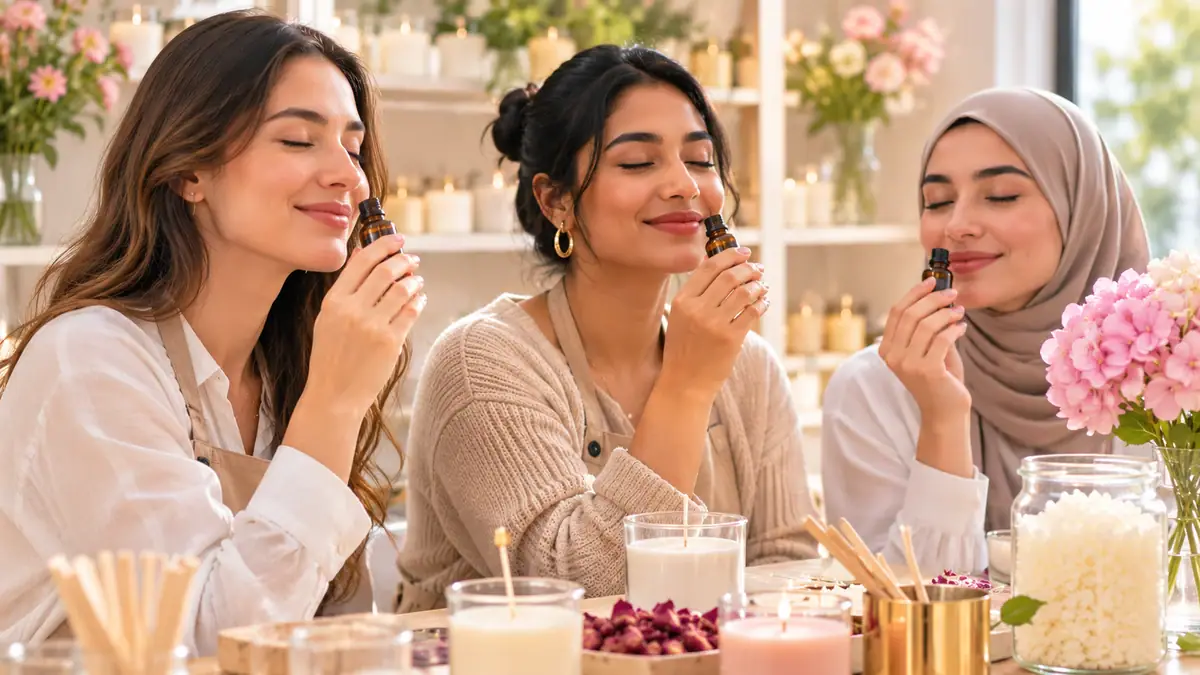
A shared fragrance is not a shared experience
Two people can smell the same candle or fragrance strip at the same moment and report surprisingly different impressions. One notices a sharp citrus opening; another describes a soft floral effect. Neither is necessarily mistaken. A fragrance is a mixture of molecules, and the brain constructs an experience from the signals arriving at its smell receptors. That construction depends on which molecules each person detects, how strongly they detect them, what they have smelled recently, and the associations they bring to the moment. Even words such as fresh, sweet and clean are learned descriptions rather than fixed chemical properties. Understanding these differences makes fragrance conversations more precise and less judgmental.
In practice, these factors operate together rather than in isolation. A useful way to interpret a disagreement is to ask whether the difference concerns detection, intensity, description or emotional response. Each points to a different part of the process, and none requires one participant to have the only correct impression.
How the nose converts molecules into a smell
Odour molecules enter the nose during breathing and reach the olfactory epithelium high in the nasal cavity. Receptor proteins on sensory neurons respond to different molecular features. Rather than having one receptor for every named fragrance, the system uses combinations of receptor activity. The brain interprets this distributed pattern as an odour. A perfume containing many ingredients may therefore produce several simultaneous signals, some stronger than others. The precise balance of those signals is part of why one person calls a blend woody while another calls it spicy. Smell also reaches the nose from the mouth during eating, which helps explain why flavour and aroma seem closely connected.
Genetic variation changes what people detect
Humans differ in genes that encode olfactory receptors. Certain genetic variants can affect sensitivity to particular odour molecules, sometimes dramatically. A note that seems prominent to one person may be faint or nearly absent to another. This is not a universal ranking of good noses and bad noses: someone who is less sensitive to one compound may be quite sensitive to another. Because fragrances contain many aromatic compounds, the overall result is more complex than a single gene deciding whether a fragrance smells pleasant. Genetic differences help explain variability, but experience, attention, exposure and context matter as well.
Sensitivity and detection are not the same as preference
Detecting an odour at a low concentration is different from liking it. A highly sensitive person may notice a note quickly and dislike it, while another may detect it just as clearly and enjoy it. People also vary in how intensely they rate an odour once they can detect it. A scent may be recognisable but not dominant, or intense but difficult to identify. Separating detection, intensity, identification and pleasantness is useful when discussing fragrance perception. Asking “Can you smell the herbal note?” tests a different question from “Does the herbal note feel comforting?” Neither answer alone reveals the full sensory experience.
Memory gives fragrance personal meaning
Smell is strongly connected with learning, emotion and autobiographical memory. A familiar aromatic note may remind someone of a relative’s kitchen, a particular holiday or a childhood garden. Another person without that history may perceive only the immediate sensory qualities. Associations can also shift over time: a smell linked to a pleasant event may become more appealing, while one connected with discomfort may be avoided. These reactions are genuine parts of fragrance perception, but they are not properties contained in the bottle.
The neurological link between scent and emotion is well-documented; exploring the psychology of scent and fragrance perception reveals why ambient aromas trigger such immediate, personal responses. The same molecule does not carry a universal memory. Its meaning develops through personal experience and cultural context.
Culture and language influence descriptions
People learn to group and describe smells through language, food traditions, household products and social experience. A note that one community calls medicinal may be described elsewhere as herbal or refreshing. Familiarity can make an odour easier to identify without necessarily making it stronger. Some people have a broad vocabulary for botanical or culinary aromas, often organized by exploring how different candle fragrance families interact across floral, woody, oriental, and fresh notes; others reach for comparisons such as soap, rain or sweets. When two people disagree about a fragrance, they may partly be choosing different words for overlapping perceptions. A useful conversation asks for examples and associations rather than assuming every label has a universal meaning.
Recent exposure can temporarily change perception
Repeated or continuous exposure to an odour can make it seem weaker, a phenomenon often called olfactory adaptation. Someone who has been in a scented room for twenty minutes may notice less than a person who has just entered. Strong background odours can also mask subtler notes. Understanding the science behind olfactory fatigue and why scents fade helps explain why our receptors naturally dial down unchanging background aromas. These short-term changes mean comparisons are most useful when people smell the same sample under similar conditions and allow time between trials. Adaptation does not mean the fragrance has vanished from the air. It means the sensory response and attention to that stimulus have changed.
Attention, expectation and labels matter
What people expect to smell can influence what they notice and how they describe it. Reading a list of notes before smelling may draw attention toward those descriptions. Without a label, a person might describe the same fragrance in more personal terms. Visual surroundings, packaging and even a fragrance name can shape interpretation, although they do not override the chemistry of the stimulus. For a fair comparison, try smelling an unlabelled sample first and writing down impressions independently. Then compare notes after everyone has described the scent in their own words.
Environment changes the stimulus itself
A fragrance may smell different because the mixture reaching the nose has changed, not only because observers differ. Temperature, ventilation, humidity, distance from the source and the material carrying the fragrance can affect evaporation and dispersion. On skin, differences in application, skin condition and time since application may alter the evolving aroma. A candle, a blotter and a fabric sample do not necessarily release ingredients at identical rates. Comparing people’s reactions therefore requires attention to where, when and how the fragrance is presented.
How to compare fragrance impressions thoughtfully
Use the same sample, similar distance and a neutral setting. Allow breaks so the nose can recover from repeated exposure. Ask each participant to record what they detect, its perceived intensity and any memories it evokes, then compare answers without declaring a winner. Consider testing again later to see which impressions remain stable. For those who want to explore these sensory layers in a structured setting, joining a guided fragrance workshop in Dubai provides hands-on practice in identifying top, heart, and base notes. This simple approach demonstrates that scent perception includes biology, learning and circumstance. It is also a reminder that a fragrance description is a guide to possible impressions, not a promise that every nose will experience the same thing.
Five Key Takeaways
- Scent perception differs biologically and experientially: Detection, memory, and surroundings combine to shape how every individual experiences fragrance.
- Genetics alter receptor sensitivity: Inherited differences in olfactory receptors mean certain people detect specific aroma molecules far more intensely than others.
- Memory and language drive description: Personal history, cultural background, and learned vocabulary influence whether a note feels comforting, fresh, or sharp.
- Adaptation and environment change the input: Airflow, room temperature, and sensory fatigue actively alter the concentration reaching your nose.
- Varying impressions are not mistakes: Differences in scent interpretation reflect individual biology rather than an incorrect reading of the fragrance.
Frequently Asked Questions
Can two people genuinely smell different notes in the same fragrance?
Yes. Differences in receptor sensitivity, attention and associations can emphasise different parts of a mixture.
Does genetics determine whether someone likes a fragrance?
No. Genetics can influence detection, but preference also reflects learning, memory and context.
Why does a familiar scent seem weaker?
Olfactory adaptation can reduce awareness during sustained exposure.
Can fragrance descriptions be objectively correct?
Ingredient information can be factual, but subjective descriptors are not guaranteed to match every person’s experience.
Does age affect smell perception?
Smell ability can change with age, although individuals vary widely.
How can friends compare a fragrance fairly?
Smell the same unlabelled sample under similar conditions, take breaks and record impressions independently.
About Studio Kinza
Studio Kinza is an artisanal fragrance studio in Warsan, International City, Dubai, creating hand-poured scented soy candles made with non-toxic waxes and premium botanical fragrance oils. The studio hosts hands-on creative workshops, masterclasses, and private events that demystify fragrance chemistry and guide guests through the art of personalized scent blending.
Plan Your Experience
Curious to test your nose and discover your personal fragrance profile? Contact the Studio Kinza team to reserve a private blending session, explore public masterclasses, or plan an interactive group scent experience.

How Temperature Affects Smell Perception
How Does Temperature Change the Way We Perceive Smell? A...
Read More
Colour Contrast Candle Label Readability
The Science of Colour Contrast: Why Some Candle Labels Are...
Read More
History Of Beeswax Candles
How Did Beeswax Candles Become Important in Historical Lighting? A...
Read More