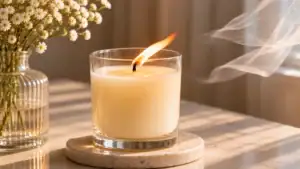
Why Can You Sometimes See a Candle Flame in Daylight?...
Read MoreWhy Can You Sometimes See a Candle Flame in Daylight?
A candle flame can be easy to see in a room flooded with daylight if it is in front of a dark background. Move your line of sight so that the same flame appears against a bright window and its outline may nearly disappear. The candle can be producing much the same amount of light in both cases. What changed was the light arriving from behind it and the contrast your eye could detect.
The useful question is therefore how bright the flame appears compared with the patch immediately behind it. Your eyes also adjust to the wider surroundings. The brightness of the background, the size of the flame in your field of view and the light scattered by glare all help determine whether the flame stands out.
This is why daylight alone cannot predict flame visibility. Direct sunlight, a shaded wall and an overcast sky create different viewing conditions. A candle can remain visible in each setting, but its edges and faint regions may be easier to see in some positions than others.

A flame emits light while most backgrounds reflect it
The luminous region of an ordinary candle sends visible light in many directions. Understanding why a candle flame is yellow clarifies how glowing incandescent soot particles generate that emitted light. Some of that light reaches your eyes. A wall behind the flame may also send light to your eyes, mainly by reflecting the light that falls on it. A window can be much brighter because it gives you a view of the illuminated sky or outdoor surfaces. The flame and background are two sources of light in the view, even though only one is burning.
Luminance is a way to describe the light coming from a surface or source in a particular direction, taking the human eye’s daytime sensitivity to different wavelengths into account. A bright patch of sky has a different luminance from a shaded wall. The same wall can appear differently when sunlight falls across it. Illuminance describes light arriving at a surface. For seeing a flame, the light reaching the observer from each patch is especially relevant.
A sunny room may have a lot of light arriving at the table while also containing a dark patch behind the candle. In that view, the flame can stand out against the patch. A dimmer room with a bright lamp directly behind the flame can create a harder view. General descriptions such as bright room and dark room leave out where the bright surfaces are in relation to the flame.
Why local contrast matters
Consider looking at a flame against a matte dark wall. The flame adds light to a patch that would otherwise appear dim. Its boundary creates a clear change in brightness across a short distance. Exploring colour contrast and label readability highlights the exact same visual principle: human eyes rely on relative luminance separation to distinguish fine edges. Now look at it against a bright surface. The flame can still add light, but that addition may be small compared with the light already arriving from behind it. The edge becomes less distinct.
A flame is partly transparent. You may see light from behind it through some regions. This means its appearance is not always like that of an opaque object with a fixed surface brightness. The light the flame emits, the light transmitted through it and effects such as refraction in the hot gases can all contribute to the view. For the familiar luminous region, the simple idea of added light against a background is often enough to explain why it becomes harder to pick out in bright conditions.
Contrast can be illustrated using hypothetical values. Suppose a small object adds ten units of visible luminance against a background of ten units. The change is large relative to the background. Against a background of one hundred units, the same addition represents a smaller relative change. These values describe a simplified comparison. They are not measurements of a particular candle or universal thresholds for the eye.
What daylight does to your eyes
Your visual system adapts to the light around you. When you enter a brightly lit space, your pupil and the sensitivity of your visual system adjust. Bright adaptation helps you see detail across the illuminated scene. It also changes how easily you detect a small difference in a tiny patch, especially if a nearby window or reflection is much brighter than the patch you are trying to examine.
Your eyes respond to both local and broader conditions. You can look towards a shaded wall while still having a bright window in the edge of your view. That window can contribute glare or affect the state of adaptation. Moving your gaze so it is outside the field of view can make a difference, even if the patch immediately behind the flame stays similar.
Give yourself a moment when moving between a bright outdoor area and a shaded room. The first impression can change as you adapt. If a candle is hard to see just after you look towards a very bright scene, that observation includes the change in your eyes as well as the lighting around the candle. A fair comparison takes place after you have spent a little time in similar conditions.
Why the background can matter more than the amount of daylight
A shaded wall and a bright window
A shaded wall can provide a relatively even background in a daylit room. Its brightness may remain low enough for the flame’s yellow region to show clearly. A window can put sky, clouds and bright buildings in the same line of sight. Their brightness varies across the opening, so the flame may be clear in front of one part and hard to see in front of another.
This explains why a small shift in viewing position can make a big difference. From one side of a table the flame might overlap a dark window frame. From a little farther along, it could overlap the sky. The candle may have stayed in the same place and remained equally steady. The comparison changes mainly because of the view behind it.
A glossy surface and a matte surface
A glossy object can reflect a small, bright image of a window or lamp. Examining how light direction changes texture and colour explains why specular reflections on polished surfaces behave differently from diffused light on matte walls. The reflection may sit beside the flame or directly behind it. A matte surface tends to spread reflected light more broadly. These two surfaces can create different visibility even when their colours look similar in ordinary light.
The finish can therefore matter more than the name of the colour. A dark polished surface can show a very bright reflection in one direction and look dark in another. A lighter matte wall can provide a more even background. If you are trying to explain a visibility change, look for highlights and reflections before assuming the flame changed.
How size and distance affect visibility
As you move farther away, a flame occupies a smaller part of your field of view. Its finest features can become hard to resolve. You may still detect the bright centre while losing the faint blue base or the thin outline. This is a difference between detecting the presence of the flame and seeing its shape in detail.
A bright background compounds the difficulty. When the flame is small and the edge adds only a modest difference in brightness, there are fewer clear visual cues to separate it from the surroundings. From closer viewing distances, the same flame can occupy a larger area and show more of its structure. Use a safe viewing position and keep the candle in place while comparing the views.
Distance can also change what appears behind the candle. If the observer moves sideways, the background may change more than the flame’s apparent size does. If the observer moves back along roughly the same line, the flame becomes smaller while the background may remain similar. Separate those two comparisons if you want to understand which factor made the largest difference.
What glare can hide
Glare can reduce the visibility of a small source even when there is a reasonable brightness difference between the source and the immediate background. Light scattered within the eye can add a veil of brightness across the view. The effect can make a weak edge or a faint blue region harder to distinguish. A strong reflection on a nearby tabletop or window can be enough to complicate the observation.
Glass around the flame adds another place for reflections. A clear jar can reflect a window from its curved surface. The bright curved line you see on the jar may move when you change your viewing angle, while the flame stays anchored near the wick. Watch which feature moves with your position. That helps distinguish the flame from the light reflected by the vessel.
You can make a similar observation with an unlit glass vessel. Notice where a bright window appears in the curve as you walk past. That simple comparison isolates a reflection without needing to change a flame. It also makes it easier to recognise why the reflection can hide part of the flame in a daylit setting.
How to compare the same flame against two backgrounds
A recorded demonstration works well for studying this effect, provided the camera exposure stays consistent. Following structured capture guidelines—like those in our guide on how to photograph candlelight—helps isolate true background luminance shifts from automatic camera exposure adjustments. Look for footage where the flame is seen against both a dark and a light patch. Identify which regions remain visible in each view. The bright core may appear in both, while the edges can be much easier to see against the darker patch.
You can also think through the comparison without a flame. Imagine a small yellow light beside a bright window and then against a shaded wall. Ask whether the light itself changed or whether the surroundings changed. Consider how far away the light is and whether a reflection overlaps it. The same questions apply when the small light source is a candle.
This way of observing keeps the explanation tied to evidence. Describe the local background, the presence of glare and which part of the flame was visible. Saying the outline disappeared against the window gives more information than saying daylight put the flame out. It also leaves room for the fact that the bright centre could still have been visible.
Colour can provide another clue
The edge of a flame may also differ in colour from its background. A yellow region against a cool grey surface can be easier to identify than the same region against a similar yellow reflection. The relative brightness still matters, especially when the flame occupies a very small part of the view. Describe colour and light-dark contrast separately if you are comparing two positions.
Key Takeaways
- Local background brightness dictates visibility: A flame stands out in daylight when placed against a dark, shaded wall, but fades when viewed against a bright window.
- Luminance contrast outweighs overall room light: Visibility depends on how much light the flame adds relative to the specific patch directly behind it.
- Bright daylight reduces eye sensitivity to faint edges: Pupil constriction and bright adaptation make subtle blue bases and outer flame outlines harder to detect.
- Glossy reflections and glass glare obscure detail: Window reflections on polished surfaces or curved candle jars can mask the flame’s true shape.
- Shifting your viewing angle alters contrast: Stepping slightly sideways changes the background and reflections behind a stationary flame without changing the burn itself.
Frequently Asked Questions
Why can I see a candle against a wall but barely see it against a window?
The wall may send less light towards your eyes than the window. The flame then makes a larger relative difference against the wall. The candle can keep burning similarly while the visibility of its outline changes.
Does daylight make a candle flame physically dimmer?
Daylight by itself does not explain a change in combustion. It can make the emitted light less conspicuous by brightening the background or producing glare. Other conditions, such as airflow from an open window, can affect the flame independently.
Why do I see only the middle of the flame in bright light?
The centre may provide enough contrast to remain detectable. The thinner edges or faint blue region add less light and can blend into the background. Distance and adaptation can make those details harder to resolve as well.
Can a black background make the flame seem brighter?
A darker background can make the flame easier to distinguish and may change how bright it appears in context. The candle itself does not need to emit more light for that change in appearance to occur.
Does a photograph show exactly what my eyes will see?
A camera’s exposure, processing and display can alter contrast. A human observer also adapts to the scene in a way that depends on the surroundings and the preceding view. A photograph can demonstrate the principle when its settings and background are understood.
Why do I sometimes see two bright shapes near a candle?
Glass can reflect a window, lamp or the flame itself. A reflection changes as your viewing position changes. The flame remains associated with the wick, so observing both positions helps distinguish them.
References: CIE definition of luminance • CIE on luminance contrast
About Studio Kinza
Studio Kinza is a Dubai-based artisanal candle studio located in Warsan, International City, crafting clean-burning handcrafted soy candles from non-toxic botanical waxes and fine fragrance oils. Through hands-on workshops, masterclasses, and educational guides, we explore the science behind candle materials, scent, and combustion.
Plan Your Experience
Curious to explore candle aesthetics, lighting science, and custom fragrance blending in a guided studio setting? Contact the Studio Kinza team to reserve workshop seats, arrange private group sessions, or enquire about bespoke candle experiences in Dubai.

Why Candle Flame Is Yellow
Why Is a Candle Flame Mostly Yellow? Understanding Incandescence The...
Read More
Candle Flame Without Gravity
Can a Candle Flame Exist Without Gravity? What Space Experiments...
Read More