
Why Does Smoke Rise from a Candle Just After You...
Read MoreWhy Does a Candle Go Out When You Cover It with a Jar?
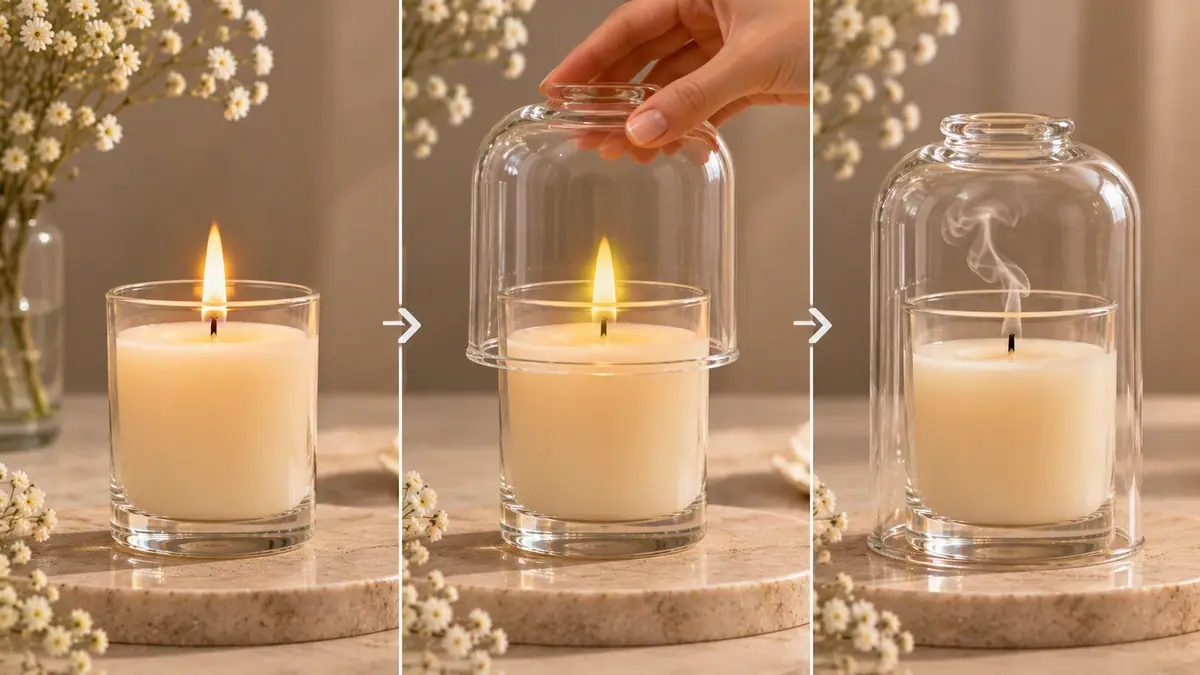
Lower a jar over a burning candle and the flame can continue for a little while. There is still air around it when the jar goes down. What changes is the supply of fresh air. As the flame burns, it uses oxygen from the air inside the jar. Eventually the conditions around the flame can no longer sustain combustion, and the light goes out.
The familiar candle oxygen experiment is a demonstration of limited oxygen supply. It is sometimes described as proof that the candle uses up every last bit of oxygen. The observation cannot establish that. A flame can stop burning while oxygen remains in the enclosed air, because the flame needs oxygen to reach it quickly enough and needs to retain enough heat to keep reacting.
The most revealing part of the demonstration is the delay between covering and extinction. That delay separates an immediate interruption, such as blowing out the flame, from a gradual change in the air available to support it.
What the flame needs from the surrounding air
A candle is a small combustion system. The flame warms wax near the wick, and the wax supplies fuel vapour. Oxygen from the surrounding air reacts with the fuel. The reaction releases energy, some of which keeps the process going by heating more fuel. Water vapour and carbon dioxide are among the main products when the fuel burns completely.
In an open room, air around the candle can be replaced as the heated gases rise. Exploring candle flame airflow science clarifies how rising warm gases continuously pull fresh oxygen inward from the surrounding room. Oxygen also moves through the gases by diffusion. Close to the flame, the rate at which it is supplied matters because the reaction is using it at the same time. The flame can remain relatively steady when incoming oxygen, fuel supply and heat loss balance.
Covering the candle changes the space from which fresh air can arrive. Inside the jar, gases can still circulate. They can carry oxygen from one region to another, but circulation inside the jar does not create new oxygen. If the rim restricts exchange with the room, there is a limited reserve of oxygen available for the flame. This is the principle demonstrated in the American Chemical Society’s Flame Out activity.
What happens between covering and extinction
The air starts out able to support a flame
When the jar first goes over the candle, most of the gas it encloses is ordinary air. That air contains oxygen, which is why a candle can remain lit after the cover is in place. Heat already present near the wick also helps the candle continue supplying fuel vapour. Some variation at this stage may come from air displaced as the cover is lowered.
Inside the jar, the flame heats nearby gases and convection can carry those gases away from the wick. As they move, they mix with the air enclosed farther from the flame. A jar is therefore more complicated than a perfectly mixed box. The gas beside the wick, above the flame and near the rim can have different temperatures and compositions at any particular moment.
The conditions move away from those needed to burn
As combustion continues, the flame consumes oxygen and contributes combustion products to the enclosed space. Understanding why candles produce black soot highlights how declining oxygen ratios disrupt complete fuel oxidation before the flame goes out entirely. If replacement air is limited, the mixture around the flame becomes less able to sustain the reaction. Reaction rates and the flame’s heat balance change together. You may notice that the flame grows smaller or less bright before it disappears, although the exact appearance depends on the setup.
The flame goes out when it can no longer maintain the chain of events that keeps it burning. It has to release enough heat to compensate for the energy leaving the hot region and to continue preparing fuel from the wax. A weaker reaction can lose that balance. The hot wick may release a brief visible plume after extinction, but the presence of that plume does not mean the flame is still burning.
Why some oxygen can remain
A burning flame and a laboratory oxygen sensor answer different questions. The flame indicates whether combustion can continue under the conditions immediately around it. A calibrated sensor can measure oxygen concentration in a sample of gas. One observation cannot automatically substitute for the other.
Imagine an enclosure where oxygen is distributed unevenly. Gas closer to the flame may be depleted faster than gas elsewhere can replace it. Even if oxygen is present farther away, the supply to the reaction zone can be inadequate. Extinction also depends on factors beyond oxygen concentration, including heat loss and the amount of combustion products mixed into the air.
This is why there is no universal oxygen percentage you can read from the moment a household candle goes out under a jar. The result can vary with the fuel, flame, enclosure and air exchange. An oxygen measurement at one point in the enclosure would still need a location and time to be meaningful. A classroom observation is well suited to demonstrating the need for a continued supply, while a quantitative measurement requires equipment and a defined procedure.
What changes when the jar is larger
A larger enclosed volume initially holds more air if the starting conditions are comparable. It therefore usually holds more oxygen. If two otherwise similar setups differ mainly in enclosed volume, the larger enclosure can allow the candle to burn for longer. Comparing those setups makes the idea of a limited oxygen reserve easier to see.
Burn time does not necessarily scale in direct proportion to the volume. A taller enclosure can change where warm gases gather. Different rim shapes can change the amount of air that leaks in. The flame can consume fuel at a different rate as the air around it changes. A container twice the volume may therefore give a longer observation without producing exactly twice the time.
If an adult instructor compares results from a published demonstration, it helps to name the conditions that stayed the same. Candle size, wick condition and the timing rule all affect what the result means. Repeating the same comparison can show how consistent it is. Any demonstration with a flame and hot glass needs an appropriate classroom setup and adult supervision. A recorded demonstration can teach the same observation without handling a hot enclosure.
What the demonstration can and cannot measure
Start the observation when the cover reaches its resting position, and note when the visible flame disappears if you are analysing a video. Keep those definitions consistent across examples—a discipline echoed in our guide on how candle burn time is measured, where strict start and stop endpoints keep comparisons valid. One viewer might count the final faint glow as flame while another stops when the yellow part disappears. Agreeing on an endpoint makes the observations easier to compare.
The measured interval is a time to extinction for that particular setup. It combines the rate at which oxygen is consumed, the way gases move and the rate at which heat leaves the flame. You cannot use the elapsed time by itself to determine the original percentage of oxygen in air. Doing so would require a validated relationship between the measured time and oxygen concentration under controlled conditions.
The version of the experiment with a shallow layer of water introduces another measurement. After the flame goes out, water can rise inside the enclosure. Its movement depends on changes in pressure, including cooling of the enclosed gases and, depending on the setup, gas exchange and condensation. The height of the water is not a direct scale for the oxygen used. The extinction observation and the water-level observation are related to the same event, but they need separate explanations. In everyday home use, applying this same oxygen-deprivation principle safely—as outlined in our expert candle care tips to make candles last longer—means extinguishing a candle with a fitted lid or snuffer rather than blowing hot wax across the vessel.
Key Takeaways
- Trapped air sustains a brief burn: A covered candle initially stays lit using the oxygen already enclosed inside the jar.
- Restricted airflow halts fresh oxygen replacement: Once the rim seals against the surface, internal circulation cannot generate new oxygen for the reaction zone.
- Extinction happens before oxygen hits zero: A flame goes out as soon as local oxygen delivery and heat retention fall below the threshold required to vaporise wax.
- Container size and geometry alter burn duration: Larger jars hold more air, though height, heat loss, and rim seal tightness prevent burn time from scaling linearly.
- Water rise reflects cooling pressure, not exact oxygen volume: In water-tray variations, thermal contraction of cooling gases accounts for most of the liquid drawn inside.
Frequently Asked Questions
Why does the flame keep burning briefly after the jar goes down?
The jar starts with air inside it. That air contains oxygen, so the reaction can continue for a short interval. The flame stops when the supply and other conditions can no longer sustain it.
Does the candle consume every bit of oxygen in the jar?
Some oxygen can remain. The flame depends on oxygen reaching its reaction zone at a sufficient rate, together with a balance of heat and fuel. A flame going out cannot establish that the entire volume is oxygen-free.
Is carbon dioxide the reason the flame goes out?
Carbon dioxide is among the combustion products that change the gas mixture. At the same time, oxygen is being consumed and the flame is losing heat. The observation reflects the combined conditions rather than a single measurement of carbon dioxide.
Why might one jar give a longer burn than another?
A larger starting air volume can provide more oxygen. Differences in shape, leakage and gas circulation can also change the result. Describe those differences before drawing conclusions from the timing.
What if the rim leaves a gap?
A gap can let air enter or gases escape, which changes the experiment. The effect depends on the gap and the air movement around the jar. A covered candle with substantial air exchange can behave differently from one in a more restricted enclosure.
Does the experiment prove that flames need air?
It shows that restricting the supply of ordinary air can extinguish a candle. The chemistry explains why oxygen in that air matters. More controlled measurements can separate the influence of oxygen from changes in gas temperature, flow and composition.
References: American Chemical Society Flame Out demonstration
About Studio Kinza
Studio Kinza is a Dubai-based artisanal candle studio located in Warsan, International City, crafting clean-burning handcrafted soy candles from non-toxic botanical waxes and fine fragrance oils. Through hands-on workshops, masterclasses, and educational guides, we explore the science behind candle materials, scent, and combustion.
Plan Your Experience
Curious to explore wick sizing, combustion science, and custom fragrance blending in a guided studio setting? Contact the Studio Kinza team to reserve workshop seats, arrange private group sessions, or enquire about bespoke candle experiences in Dubai.

How Light Direction Changes Texture And Colour
How Does Light Direction Change the Appearance of Texture and...
Read More
How Temperature Affects Smell Perception
How Does Temperature Change the Way We Perceive Smell? A...
Read More