

Why Does Candle Wax Shrink as It Cools? The Science...
Read MoreWhy Does Candle Wax Shrink as It Cools? The Science of Solidification
Why does this happen? The answer becomes clearer when we examine what happens to materials and energy rather than relying on how a candle looks at first glance. Everyday candle observations provide a surprisingly accessible introduction to physics and chemistry, but a familiar appearance can have more than one cause.
This Studio Kinza guide explores why candle wax shrinks as it cools for curious readers, students and hobby makers. It follows the mechanisms involved, explains which conclusions are reasonable, and separates useful observations from claims that would require controlled measurement. The aim is understanding rather than a shopping guide or a universal recipe.
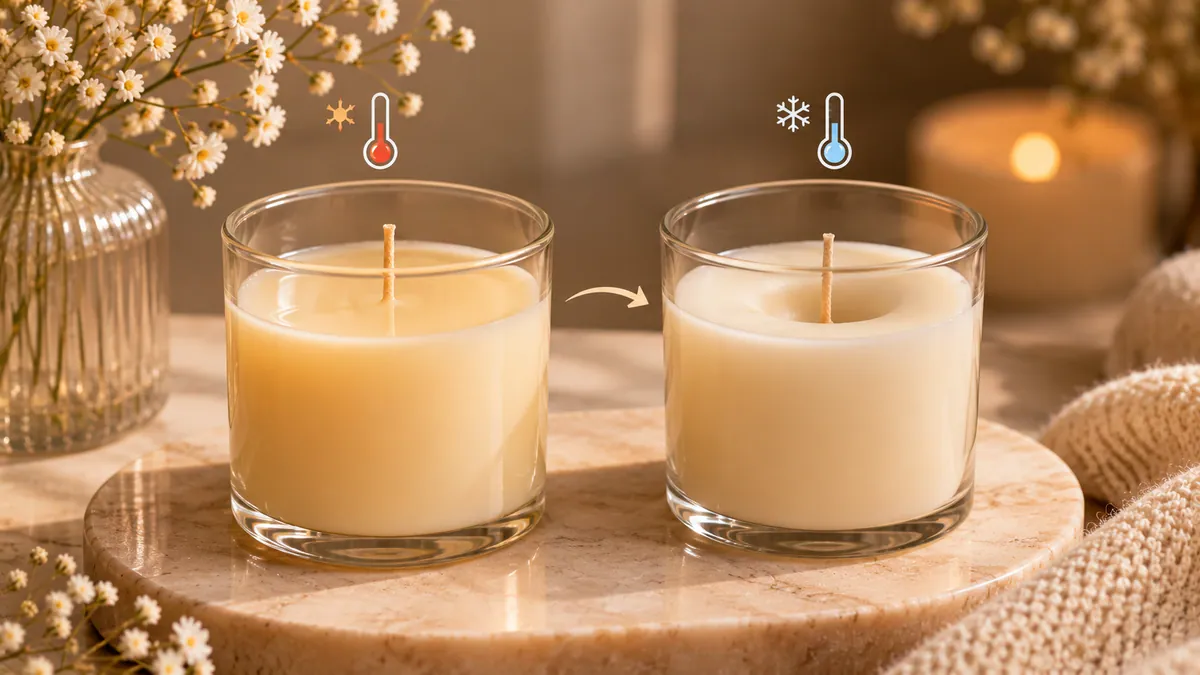
What happens as liquid wax solidifies
Molten wax is a liquid mixture of molecules moving relatively freely. As it cools, components organise into solid structures. Density often changes during this transition, so the final solid can occupy less volume than the hot liquid.
To understand this point, pay attention to the sequence of events rather than only the final result. Ask what changes first, what must be present for the process to continue, and which surrounding conditions could alter what you see. In the context of why candle wax shrinks as it cools, that approach is more reliable than attributing every difference to one ingredient or one moment of observation. It also helps distinguish a plausible explanation from something that has actually been measured.
Thermal contraction versus solidification shrinkage
Cooling within a single phase can reduce volume through thermal contraction. The transition from liquid to solid can produce an additional volume change. Both may contribute to a visible dip, but they are distinct physical processes.
Why the surface can sink
The top surface may begin to solidify while the interior remains warm. As deeper wax cools and contracts, it can leave a depression or internal void. This is why the final shape is influenced by how heat leaves the container over time.
Cooling rate changes the result
A rapid temperature drop can create larger gradients between the outer wax and the centre. Understanding candle curing vs cooling clarifies how slow, controlled cooling produces a different crystal structure and surface appearance than sudden thermal drops. Neither outcome is universal across all waxes or vessel shapes.
The role of the container
Glass, metal and ceramic conduct and store heat differently. Learning how to choose a candle vessel for DIY candle making highlights how wall thickness and material conductivity alter cooling rates. A thick vessel can cool at a different rate from a thin one. Container shape also affects how much wax is near a wall and how heat escapes.
Why different waxes behave differently
Soy, paraffin and blended waxes have different melting ranges, crystallisation behaviours and thermal properties. Comparing soy wax vs paraffin wax candles shows why mineral paraffin typically experiences higher volume contraction than softer botanical soy blends. Their shrinkage cannot be predicted from one generic number. Additives and fragrance may change the behaviour of the finished mixture.
Sinkholes and air pockets
A visible depression is not always proof of a hidden void, and a smooth top does not guarantee that the interior is completely uniform. Internal pockets can arise when solidification patterns trap space. Reviewing common candle mistakes and how to avoid them helps makers spot and remedy subsurface air cavities before lighting. Observations should distinguish surface appearance from unseen structure.
A no-flame demonstration
Observe a small amount of a safe classroom phase-change material under teacher supervision, recording its level before and after cooling. This can illustrate volume change, but the result will not quantify candle-wax shrinkage. Never heat candle wax without appropriate equipment and supervision.
Why timing matters
A candle may look solid at the surface while the centre remains warmer. Subsequent cooling can still change its shape. This helps explain why evaluating the surface immediately after pouring can be misleading.
The underlying physics
Energy leaves the wax, molecular motion changes, crystals or solid phases form, and the material’s volume responds. A depression is the visible consequence of these linked events, not evidence that wax simply disappeared.
How to interpret the observation
A useful scientific explanation begins with what can actually be observed, then asks which physical or chemical processes could produce it. Avoid assuming that a single visible feature reveals the entire system. Candle behaviour involves materials, heat, surrounding air and time, so one observation often has several plausible contributors.
What changes between real candles
The details depend on wax composition, wick structure, vessel dimensions and environmental conditions. Small differences in these inputs can change the outcome without changing the underlying scientific principle. This is why a mechanism can be well understood while its exact appearance varies from candle to candle.
Common misconception to avoid
An attractive or familiar description can conceal an incorrect causal explanation. Separate a useful analogy from a literal mechanism, and do not infer safety, performance or chemical composition from appearance alone. When a claim would require measurement, treat it as a hypothesis rather than a proven conclusion.
How to think about evidence
Reliable comparisons keep conditions as similar as possible and record more than one observation. Temperature, ventilation, lighting and timing are easy to overlook. A photograph or one brief burn can illustrate a phenomenon, but it rarely establishes a universal rule for every candle.
Five Key Takeaways
- What happens as liquid wax solidifies: Molten wax molecules pack into tighter solid crystal lattices, occupying less volume than hot liquid.
- Thermal contraction versus solidification shrinkage: Both temperature drops within a single phase and the liquid-to-solid phase shift reduce overall wax volume.
- Why the surface can sink: When outer layers crust over first, deeper interior wax contracts downward and pulls the center inward.
- Cooling rate changes the result: Rapid or drafty cooling creates steep thermal gradients that exaggerate surface dips and internal voids.
- The role of the container: Vessel wall thickness and materials like glass, ceramic, or tin dictate how fast heat escapes the wax core.
Frequently Asked Questions
What is the simplest explanation of why candle wax shrinks as it cools?
Molten wax is a liquid mixture of molecules moving relatively freely. As it cools, components organise into solid structures. Density often changes during this transition, so the final solid can occupy less volume than the hot liquid.
Is why candle wax shrinks as it cools the same for every candle?
Cooling within a single phase can reduce volume through thermal contraction. The transition from liquid to solid can produce an additional volume change. Both may contribute to a visible dip, but they are distinct physical processes.
Can I identify the cause just by looking?
An attractive or familiar description can conceal an incorrect causal explanation. Separate a useful analogy from a literal mechanism, and do not infer safety, performance or chemical composition from appearance alone. When a claim would require measurement, treat it as a hypothesis rather than a proven conclusion.
Does the surrounding environment matter?
The details depend on wax composition, wick structure, vessel dimensions and environmental conditions. Small differences in these inputs can change the outcome without changing the underlying scientific principle. This is why a mechanism can be well understood while its exact appearance varies from candle to candle.
Is there a safe way to observe the effect?
Observe a small amount of a safe classroom phase-change material under teacher supervision, recording its level before and after cooling. This can illustrate volume change, but the result will not quantify candle-wax shrinkage. Never heat candle wax without appropriate equipment and supervision.
What should beginners remember about why candle wax shrinks as it cools?
Reliable comparisons keep conditions as similar as possible and record more than one observation. Temperature, ventilation, lighting and timing are easy to overlook. A photograph or one brief burn can illustrate a phenomenon, but it rarely establishes a universal rule for every candle.
About Studio Kinza
Studio Kinza is a Dubai-based artisanal candle studio located in Warsan, International City, crafting clean-burning handcrafted soy candles from non-toxic botanical waxes and fine fragrance oils. Through hands-on workshops, masterclasses, and educational guides, we explore the science behind candle materials, scent, and combustion.
Plan Your Experience
Curious to explore pour temperatures, wax formulations, and custom fragrance blending in a guided studio setting? Contact the Studio Kinza team to reserve workshop seats, arrange private group sessions, or enquire about bespoke candle experiences in Dubai.


Candle Flame Temperature Zones
How Hot Is a Candle Flame? Understanding Its Different Temperature...
Read More