

Why Does Candle Wax Shrink as It Cools? The Science...
Read MoreWhat Happens to a Candle Flame in a Moving Air Current?
Why does this happen? The answer becomes clearer when we examine what happens to materials and energy rather than relying on how a candle looks at first glance. Everyday candle observations provide a surprisingly accessible introduction to physics and chemistry, but a familiar appearance can have more than one cause.
This Studio Kinza guide explores candle flame airflow science for curious readers, students and hobby makers. It follows the mechanisms involved, explains which conclusions are reasonable, and separates useful observations from claims that would require controlled measurement. The aim is understanding rather than a shopping guide or a universal recipe.
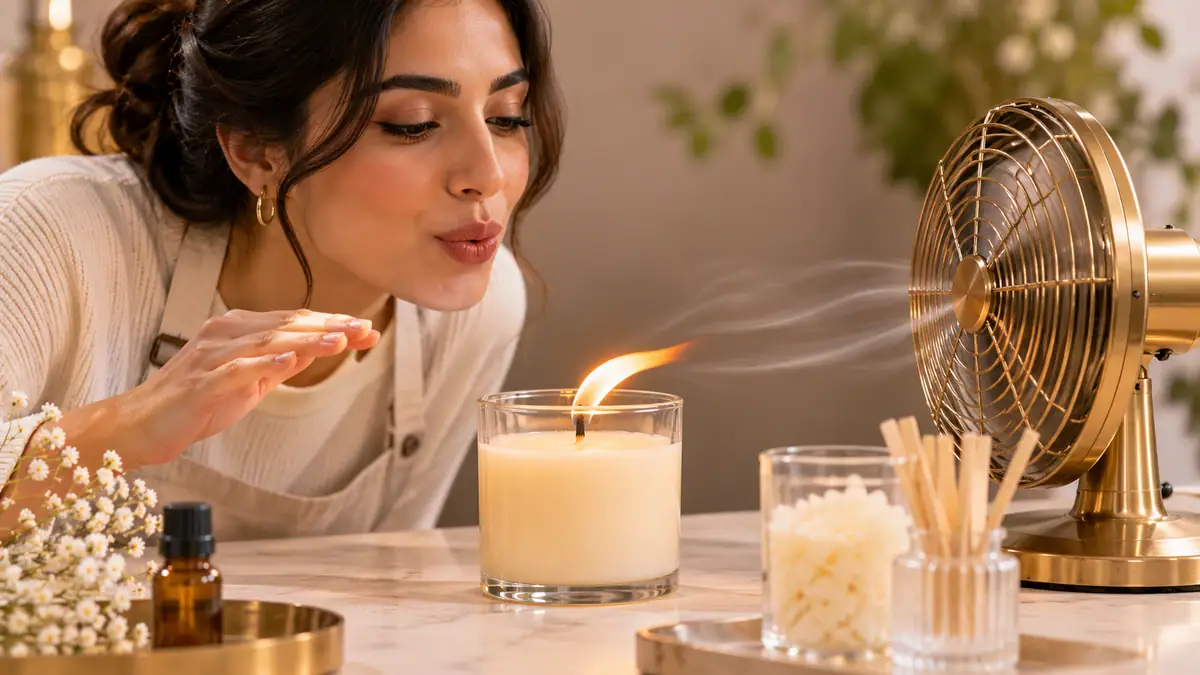
Why a flame bends in moving air
A candle flame is a rising column of hot reacting gases. A horizontal air current adds sideways motion, so the plume is deflected. The flame’s shape reflects the combined upward buoyant flow and the direction of the surrounding air.
To understand this point, pay attention to the sequence of events rather than only the final result. Ask what changes first, what must be present for the process to continue, and which surrounding conditions could alter what you see. In the context of candle flame airflow science, that approach is more reliable than attributing every difference to one ingredient or one moment of observation. It also helps distinguish a plausible explanation from something that has actually been measured.
Weak airflow versus strong airflow
A gentle current may cause a modest lean. Stronger or irregular flow can stretch, flicker or destabilise the flame. There is no universal speed at which these changes begin because wick, flame size and nearby surfaces all matter.
The importance of oxygen mixing
Airflow can bring oxygen toward fuel-rich regions, but it can also cool and distort the flame. More air is not automatically better combustion. The effect depends on whether oxygen mixes effectively without excessively disrupting the reaction zone.
Convection is already present
Even without an external breeze, hot gases rise and surrounding air moves inward. Examining why a candle flame is teardrop shaped illustrates how this natural upward buoyancy establishes a continuous self-generated current. A moving air current interacts with this existing flow. Understanding both helps explain why the flame does not simply point in the direction of the wind.
What changes first
Often the most obvious response is a change in the flame outline or angle. Brightness, soot formation and burn rate may also change as mixing and heat transfer shift. Understanding why candles produce black soot highlights how stretched flames allow unburned carbon particles to escape before full oxidation occurs. These effects are linked but should be described separately.
A controlled observation without a flame
Use a lightweight ribbon suspended near, but not in, a stream of air from a small fan to see how flow direction can bend a flexible object. This is an analogy for deflection, not a combustion experiment. Avoid directing a fan at a burning candle.
If observing a real candle
Use only normal room conditions, maintain a safe distance and note whether existing ventilation correlates with a consistent flame lean. Do not deliberately create strong drafts, place paper near the flame or move a lit candle.
Why walls and corners matter
Air flows around furniture and surfaces, creating local patterns. A candle near a wall may experience a different current from one in the centre of a table. Consequently, room geometry is part of the experiment.
Airflow and heat transfer
Moving air can carry heat away and alter the temperatures of the flame and nearby wax. Exploring why candle wax melts and the science of candle making clarifies how heat loss across the surface can create an uneven melt pool. This changes the energy balance that sustains vaporisation. The effect is not captured by considering oxygen supply alone.
How this differs from ordinary flicker
Flickering can happen with tiny, fluctuating currents even in a room that feels still, as explored in our guide on why a candle flame flickers without wind. Here the emphasis is a measurable or identifiable directional air current and the flame’s response to it. Keeping the questions separate makes each observation clearer.
How to interpret the observation
A useful scientific explanation begins with what can actually be observed, then asks which physical or chemical processes could produce it. Avoid assuming that a single visible feature reveals the entire system. Candle behaviour involves materials, heat, surrounding air and time, so one observation often has several plausible contributors.
What changes between real candles
The details depend on wax composition, wick structure, vessel dimensions and environmental conditions. Small differences in these inputs can change the outcome without changing the underlying scientific principle. This is why a mechanism can be well understood while its exact appearance varies from candle to candle.
Common misconception to avoid
An attractive or familiar description can conceal an incorrect causal explanation. Separate a useful analogy from a literal mechanism, and do not infer safety, performance or chemical composition from appearance alone. When a claim would require measurement, treat it as a hypothesis rather than a proven conclusion.
How to think about evidence
Reliable comparisons keep conditions as similar as possible and record more than one observation. Temperature, ventilation, lighting and timing are easy to overlook. A photograph or one brief burn can illustrate a phenomenon, but it rarely establishes a universal rule for every candle.
Five Key Takeaways
- Why a flame bends in moving air: A horizontal air current pushes against the rising column of hot gases, deflecting the flame at an angle.
- Weak airflow versus strong airflow: Gentle breezes cause a steady lean, whereas strong or turbulent drafts stretch and destabilise combustion.
- The importance of oxygen mixing: Excess airflow cools the reaction zone faster than oxygen can sustain clean, complete fuel vaporisation.
- Convection is already present: External drafts collide with the flame’s own upward thermal buoyancy rather than simply blowing it sideways.
- What changes first: Flame angle and silhouette shift immediately, followed by changes in luminosity, soot release, and uneven wax melting.
Frequently Asked Questions
What is the simplest explanation of candle flame airflow science?
A candle flame is a rising column of hot reacting gases. A horizontal air current adds sideways motion, so the plume is deflected. The flame’s shape reflects the combined upward buoyant flow and the direction of the surrounding air.
Is candle flame airflow science the same for every candle?
A gentle current may cause a modest lean. Stronger or irregular flow can stretch, flicker or destabilise the flame. There is no universal speed at which these changes begin because wick, flame size and nearby surfaces all matter.
Can I identify the cause just by looking?
An attractive or familiar description can conceal an incorrect causal explanation. Separate a useful analogy from a literal mechanism, and do not infer safety, performance or chemical composition from appearance alone. When a claim would require measurement, treat it as a hypothesis rather than a proven conclusion.
Does the surrounding environment matter?
The details depend on wax composition, wick structure, vessel dimensions and environmental conditions. Small differences in these inputs can change the outcome without changing the underlying scientific principle. This is why a mechanism can be well understood while its exact appearance varies from candle to candle.
Is there a safe way to observe the effect?
Air flows around furniture and surfaces, creating local patterns. A candle near a wall may experience a different current from one in the centre of a table. Consequently, room geometry is part of the experiment.
What should beginners remember about candle flame airflow science?
Reliable comparisons keep conditions as similar as possible and record more than one observation. Temperature, ventilation, lighting and timing are easy to overlook. A photograph or one brief burn can illustrate a phenomenon, but it rarely establishes a universal rule for every candle.
About Studio Kinza
Studio Kinza is a Dubai-based artisanal candle studio located in Warsan, International City, crafting clean-burning handcrafted soy candles from non-toxic botanical waxes and fine fragrance oils. Through hands-on workshops, masterclasses, and educational guides, we explore the science behind candle materials, scent, and combustion.
Plan Your Experience
Curious to explore wick sizing, combustion physics, and custom fragrance blending in a guided studio setting? Contact the Studio Kinza team to reserve workshop seats, arrange private group sessions, or enquire about bespoke candle experiences in Dubai.
Candle Flame Temperature Zones
How Hot Is a Candle Flame? Understanding Its Different Temperature...
Read More