

Why Does Candle Wax Shrink as It Cools? The Science...
Read MoreHow Does a Candle Wick Draw Liquid Wax to the Flame?
Why does this happen? The answer becomes clearer when we examine what happens to materials and energy rather than relying on how a candle looks at first glance. Everyday candle observations provide a surprisingly accessible introduction to physics and chemistry, but a familiar appearance can have more than one cause.
This Studio Kinza guide explores how candle wicks draw liquid wax for curious readers, students and hobby makers. It follows the mechanisms involved, explains which conclusions are reasonable, and separates useful observations from claims that would require controlled measurement. The aim is understanding rather than a shopping guide or a universal recipe.

Capillary action begins in tiny spaces
A wick contains narrow channels between fibres or within its structure. Liquid wax wets these surfaces and can be pulled through them by surface tension and adhesion. This movement is called capillary action. The wax is not sucked upward by the flame like liquid through a straw; interactions at the liquid–solid boundary help transport it.
To understand this point, pay attention to the sequence of events rather than only the final result. Ask what changes first, what must be present for the process to continue, and which surrounding conditions could alter what you see. In the context of how candle wicks draw liquid wax, that approach is more reliable than attributing every difference to one ingredient or one moment of observation. It also helps distinguish a plausible explanation from something that has actually been measured.
Why wax must melt first
Solid wax cannot flow through a wick in the same way as a liquid. Understanding why candle wax melts and the science of candle making highlights how radiant heat creates a liquid fuel reservoir around the base of the wick. That pool supplies liquid fuel. Without a sufficient supply of melted wax, fuel transport becomes limited and the flame can weaken.
Adhesion, cohesion and surface tension
Adhesion describes attraction between liquid wax and wick material; cohesion describes attraction among wax molecules. Surface tension reflects the energetic cost of the liquid surface. Together with the geometry of small pores, these properties influence how liquid rises and spreads. The effect depends on the actual wax blend and wick structure.
Where the wax burns
A common misconception is that the solid wax block burns directly. Much of the candle’s fuel reaches the hot zone as liquid, then vaporises. It is the fuel vapour reacting with oxygen that sustains the luminous flame. The wick is a transport structure and also undergoes heating and degradation.
Why pore size matters
Smaller capillaries can create stronger capillary pressure, but very narrow pathways can also restrict flow. Larger channels may allow faster movement but weaker capillary rise. Learning how to choose the right wick for a homemade candle helps makers match braid density and fibre structure to specific wax blends, while exploring why wooden candle wicks crackle shows how natural wood pores conduct fuel differently from twisted cotton. Successful transport is therefore a balance, not simply a case of choosing the thickest or finest wick.
Viscosity and temperature
Warm liquid wax generally flows more readily than cooler wax because viscosity changes with temperature. Different wax formulations also have different flow characteristics. This is one reason why fuel delivery cannot be predicted from wick appearance alone. Heat, liquid properties and pore geometry all matter.
Gravity and continuous supply
Capillary forces must act against gravity when fuel moves upward. A candle flame continuously consumes vapour, so the wick must keep supplying liquid from the melt pool. If the balance between supply and consumption changes, flame behaviour may change too.
A simple classroom analogy
Place the end of a strip of absorbent paper into coloured water and watch the liquid spread. The visible rise illustrates capillary transport through many small spaces. Water and paper are not wax and wick, so the experiment demonstrates the principle rather than reproducing candle combustion. No flame is needed.
What happens when fuel supply is disrupted
A wick may be obstructed by deposits or poorly matched to the wax system. The melt pool might not reach the wick consistently, or fuel may arrive too slowly. Examining why your candle is tunneling and how to fix it helps explain how insufficient thermal pools starve the wick of liquid fuel. These conditions can contribute to weak burning or extinction, but any diagnosis requires examining the whole candle rather than blaming capillarity alone.
A useful process diagram
Follow the sequence: solid wax absorbs heat → liquid melt pool forms → liquid travels through wick channels → wax vaporises near the flame → vapour reacts with oxygen. The steps overlap in time and form a self-sustaining feedback loop while fuel and oxygen remain available.
How to interpret the observation
A useful scientific explanation begins with what can actually be observed, then asks which physical or chemical processes could produce it. Avoid assuming that a single visible feature reveals the entire system. Candle behaviour involves materials, heat, surrounding air and time, so one observation often has several plausible contributors.
What changes between real candles
The details depend on wax composition, wick structure, vessel dimensions and environmental conditions. Small differences in these inputs can change the outcome without changing the underlying scientific principle. This is why a mechanism can be well understood while its exact appearance varies from candle to candle.
Common misconception to avoid
An attractive or familiar description can conceal an incorrect causal explanation. Separate a useful analogy from a literal mechanism, and do not infer safety, performance or chemical composition from appearance alone. When a claim would require measurement, treat it as a hypothesis rather than a proven conclusion.
How to think about evidence
Reliable comparisons keep conditions as similar as possible and record more than one observation. Temperature, ventilation, lighting and timing are easy to overlook. A photograph or one brief burn can illustrate a phenomenon, but it rarely establishes a universal rule for every candle.
Five Key Takeaways
- Capillary action begins in tiny spaces: A wick contains narrow channels between fibres or within its structure that pull liquid upward via surface tension.
- Why wax must melt first: Solid wax cannot flow through a wick in the same way as a liquid, requiring an active melt pool to supply fuel.
- Adhesion, cohesion and surface tension: Adhesion describes attraction between liquid wax and wick material; cohesion describes attraction among wax molecules.
- Where the wax burns: A common misconception is that the solid wax block burns directly, whereas it is actually vaporised liquid fuel reacting with oxygen.
- Why pore size matters: Smaller capillaries can create stronger capillary pressure, but very narrow pathways can also restrict fuel flow rates.
Frequently Asked Questions
What is the simplest explanation of how candle wicks draw liquid wax?
A wick contains narrow channels between fibres or within its structure. Liquid wax wets these surfaces and can be pulled through them by surface tension and adhesion. This movement is called capillary action. The wax is not sucked upward by the flame like liquid through a straw; interactions at the liquid–solid boundary help transport it.
Is how candle wicks draw liquid wax the same for every candle?
Solid wax cannot flow through a wick in the same way as a liquid. Heat from the flame creates a melt pool around the base of the wick. That pool supplies liquid fuel. Without a sufficient supply of melted wax, fuel transport becomes limited and the flame can weaken.
Can I identify the cause just by looking?
An attractive or familiar description can conceal an incorrect causal explanation. Separate a useful analogy from a literal mechanism, and do not infer safety, performance or chemical composition from appearance alone. When a claim would require measurement, treat it as a hypothesis rather than a proven conclusion.
Does the surrounding environment matter?
The details depend on wax composition, wick structure, vessel dimensions and environmental conditions. Small differences in these inputs can change the outcome without changing the underlying scientific principle. This is why a mechanism can be well understood while its exact appearance varies from candle to candle.
Is there a safe way to observe the effect?
Place the end of a strip of absorbent paper into coloured water and watch the liquid spread. The visible rise illustrates capillary transport through many small spaces. Water and paper are not wax and wick, so the experiment demonstrates the principle rather than reproducing candle combustion. No flame is needed.
What should beginners remember about how candle wicks draw liquid wax?
Reliable comparisons keep conditions as similar as possible and record more than one observation. Temperature, ventilation, lighting and timing are easy to overlook. A photograph or one brief burn can illustrate a phenomenon, but it rarely establishes a universal rule for every candle.
About Studio Kinza
Studio Kinza is a Dubai-based artisanal candle studio located in Warsan, International City, crafting clean-burning handcrafted soy candles from non-toxic botanical waxes and fine fragrance oils. Through hands-on workshops, masterclasses, and educational guides, we explore the science behind candle materials, scent, and combustion.
Plan Your Experience
Curious to explore wick sizing, wax chemistry, and fragrance blending in a guided studio setting? Contact the Studio Kinza team to reserve workshop seats, arrange private group sessions, or enquire about bespoke candle experiences in Dubai.


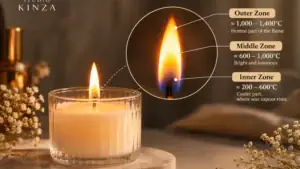
Candle Flame Temperature Zones
How Hot Is a Candle Flame? Understanding Its Different Temperature...
Read More