
Why Does Candle Wax Shrink as It Cools? The Science...
Read MoreCandle Curing vs Cooling: Why They Are Not the Same Process
Candle Curing vs Cooling: Why They Are Not the Same Process It is a question that becomes easier to answer once we distinguish everyday language from the underlying chemistry and physics. The way aromatic materials and candle wax behave is shaped by composition, temperature, time and the surrounding environment. A simple label or first impression rarely tells the full story.
This Studio Kinza guide explains the science behind candle curing vs cooling for curious readers and makers. Rather than presenting a shopping list or a universal recipe, it focuses on mechanisms, observations and practical ways to think critically about what you see or smell. The examples are educational; specific formulas and finished candles still require appropriate supplier guidance and safety testing.
Cooling begins as soon as a candle is poured
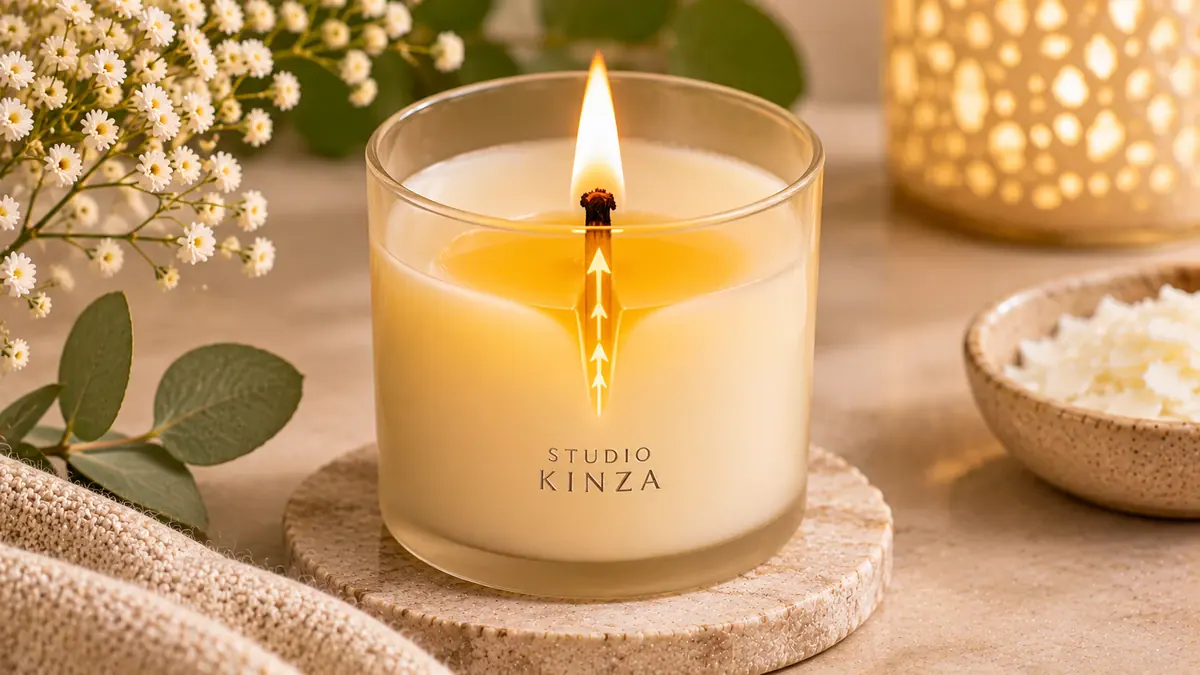
Freshly poured wax loses heat to the vessel and surrounding air. The outer regions may solidify before the centre, and the surface can appear set while the interior remains warm. Cooling is a physical temperature change that includes the transition from liquid to solid. It happens on a relatively short timescale, but the exact duration depends on wax, container size, room temperature and pouring conditions.
For a beginner, the key is to separate a visible observation from a proposed mechanism. Ask what changed, which variables were controlled, and whether another explanation fits the evidence. Scientific explanations are strongest when they can be checked rather than repeated as workshop folklore.
What candle curing means
Curing refers to changes that continue after the candle has visibly solidified. Depending on the wax blend, crystal structure may reorganise and the distribution of fragrance within the solid matrix may evolve. Makers use the word curing as a practical waiting period before evaluating a candle. It should not be confused with a chemical reaction that must occur in every candle.
Consider the distinction between an ingredient and a finished system. The same material may behave differently when its concentration, surrounding ingredients or temperature changes. This is why isolated facts about a raw material cannot predict every outcome in a completed candle or fragrance.
Why a solid candle may not be ready for evaluation
A candle that feels firm can still be undergoing structural changes. Testing too soon can make results difficult to compare with candles allowed to rest under consistent conditions. Fragrance performance depends on many variables, and curing is only one. A rested candle is not guaranteed to have better scent throw; the correct approach is repeatable testing.
Wax crystallisation during cooling
Soy-based waxes contain triglycerides that can form crystalline structures as they solidify. Cooling rate, composition and temperature variation influence crystal size and arrangement. This can affect surface appearance, adhesion and texture. Crystallisation is a useful way to understand why two apparently identical pours may look different even when both are fully solid.
Think about time as another experimental variable. Some effects are immediate, while others develop gradually under storage or repeated temperature changes. A single photograph taken on the day of manufacture cannot establish long-term stability. Repeated observations provide a more complete picture.
What changes during the rest period
Post-pour changes can include further crystal organisation, thermal equilibration and changes in how fragrance components partition within wax. The extent of these effects varies by formulation. It is more accurate to describe curing as formulation-dependent than to promise a universal molecular process or a fixed improvement in performance.
Cooling time versus curing time
Cooling time answers: when is the candle physically cool and set enough to handle? Curing time answers: when should the maker assess the candle under a consistent test protocol? A small container may cool sooner than a large one, while a maker may still choose to wait before a burn test. The two clocks measure different things.
Does every wax need the same cure period?
No. Soy, paraffin, coconut blends and other formulations have different compositions and thermal behaviour. Understanding the structural differences when comparing soy wax vs paraffin wax candles clarifies why botanical triglyceride matrices require longer stabilization windows than mineral-based waxes. Additives and fragrance loads change the system further. Supplier guidance offers a starting point, but there is no scientifically justified single cure duration for every candle. Record the wax identity and use the same rest interval for meaningful comparisons.
A controlled comparison experiment
Pour two or three otherwise identical candles using the same wax batch, fragrance percentage, vessel, wick and pouring procedure. Label them and allow them to rest for different intervals. Evaluate appearance and burning under the same conditions, keeping safety precautions constant. Compare observations rather than assuming the longest rest period must win.
Common misunderstandings
Cooling does not mean the candle has finished every possible structural change. Curing does not mean that a poorly matched wick will correct itself, nor does it guarantee that fragrance will become stronger indefinitely. Learning how to choose the right wick for a homemade candle is essential before testing, as combustion physics cannot be fixed by rest time alone. Surface frosting does not by itself prove a candle was under-cured. Reviewing common candle mistakes and how to avoid them helps makers distinguish observable physical results from workshop myths that still need proper testing.
How to document the process
Keep notes on pour temperature, ambient conditions, wax formulation, fragrance load, vessel, date and test date. Photograph the surface at consistent intervals. During any burn test, follow candle safety guidance and record flame behaviour, melt pool and scent impressions.
For makers eager to practice precision pouring, thermal monitoring, and scent formulation in person, joining a guided candle making workshop in Dubai offers hands-on instruction in managing wax behavior from melt to cure. Consistent records turn curing from folklore into a testable variable.
Five Key Takeaways
- Cooling is an immediate phase change: Cooling describes the rapid physical transition of liquid wax losing heat and solidifying in its vessel.
- Curing is post-solidification stabilization: Curing refers to the extended rest period where internal crystal structures and fragrance binding equilibrate.
- Firmness does not mean test-ready: A candle that feels hard to the touch may still be undergoing internal polymorphic crystal shifts.
- Curing times vary by wax chemistry: Natural soy and coconut blends require different rest schedules compared to mineral-based paraffin waxes.
- Curing cannot fix structural errors: Waiting longer will not correct an oversized wick, improper fragrance load, or poor pouring temperatures.
Frequently Asked Questions
Is cooling the same as curing?
No. Cooling is the physical thermal drop that turns molten wax solid, usually within hours. Curing is the subsequent rest period over days or weeks during which the wax’s crystal lattice settles and fragrance molecules stabilize within the solid matrix.
Does a hard candle need more time?
Often, yes. Even after a candle feels completely firm to the touch, botanical waxes like soy continue undergoing microscopic crystal organisation and thermal equilibration, making a rest period helpful before conducting consistent burn tests.
Does every soy candle have the same cure time?
No. Cure times depend on the specific soy wax blend, botanical additives, fragrance oil composition, and container size. Always follow the specific wax manufacturer’s guidelines and maintain a consistent rest window when testing batches.
Can curing repair a wrong wick?
No. Curing allows wax crystals and fragrance distribution to stabilize, but it cannot compensate for a wick that is too large, too small, or incompatible with the wax viscosity and vessel diameter.
Why does wax structure change after pouring?
Botanical waxes consist of triglycerides that form polymorphic crystal structures as they cool. Over time, less stable crystals slowly transition into denser, more stable arrangements, which can subtly change surface texture and burn behavior.
How can I compare cure times?
Pour two or three identical candles from the exact same batch using the same vessel, wick, and fragrance load. Label each with its pour date and test them under identical room conditions at staggered intervals, such as 3 days, 7 days, and 14 days.
About Studio Kinza
Studio Kinza is a Dubai-based artisanal candle studio located in Warsan, International City, crafting clean-burning handcrafted soy candles from non-toxic botanical waxes and fine fragrance oils. Through hands-on workshops, masterclasses, and educational guides, we explore the physics and chemistry of mindful candle making.
Plan Your Experience
Ready to master the craft of pouring and scent formulation in a guided studio setting? Contact the Studio Kinza team to reserve workshop seats, arrange private group sessions, or enquire about bespoke candle experiences in Dubai.
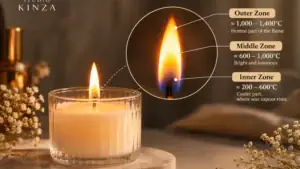
Candle Flame Temperature Zones
How Hot Is a Candle Flame? Understanding Its Different Temperature...
Read More